Carex
Cyperaceae family
Intermountain Flora, v. 6, p. 95
See also: "Field guide to sedge species of the Rocky Mountain Region" by Johnston, Barry C. 2001.
androgynous - male flowers above the female flowers in same spike or spikelet.
gynaecandrous - female flowers above the male flowers in same spike or spikelet.
A culm is termed either phyllopodic or aphyllopodic, depending on the leaf sheaths at the base of the culm. If the leaf sheath has a leaf blade attached to it, it is called phyllopodic; but if it has no blade – it is just a bladeless sheath – then it is called aphyllopodic.
- 1. Spikes solitary, terminating the culm; perigynium often containing a vestigial rachilla as well as the achene. Group 1. subgenus Primocarex
- 1' Spikes 2-many (in C. cordillerana, of Group 4, one spike terminal and one or more basal or nearly so); perigynium never containing a rachilla.
- 2. Stigmas 2 or 3 and the achene accordingly lenticular or trigonous; if stigmas 2, then the spikes elongate and cylindric (the larger ones seldom under 1.5 cm long), or at least some of them evidently pedunculate, or both; perigynium without a dorsal suture. subgenus Carex
- 3. Style continuous with the achene and of the same bony texture, not withering, often becoming flexuous or contorted; stigmas 3 and achene trigonous, except in C. saxatilis; leaves often septate-nodulose. Group 2
- 3' Style decidious; other characters various.
- 4. Stigmas 3 and the achene trigonous. (A few lenticular, distigmatic achenes seldom intermingled with the others.)
- 5. Perigynia more or less pubescent. (A few specimens of C. scirpoidea, a more or less dioecious species otherwise belonging to Group 1, would be sought here.) Group 3
- 5' Perigynia glabrous. Group 4
- 4' Stigmas 2 and achenes lenticular. Group 5
- 2' Stigmas 2 and achenes lenticular; spikes sessile and relatively short (seldom over 1.5 cm long), not elongate and cylindric; peryginium usually with a more or less evident dorsal suture, at least distally. subgenus Vignea
- 6. Spikes androgynous, or the plant more or less dioecious and most or all of the spikes unisexual. Group 6
- 6' Spikes gynaecandrous, or some of the lateral ones wholly pistillate.
- 7. Perigynia planoconvex, often with raised margins, but not thin-edged. Group 7
- 7' Perigynia planoconvex or flattened, evidently thin-edged or wing-margined (sect. Ovales). Group 8
Group 1. subgenus Primocarex
- 1. Achene relatively very large, mostly 4-6 mm long; perigynia few, 5-8 mm long, beakless or nearly so (Firmiculmes).
- 2. Plants distinctly rhizomatous, although the stems may be more or less clustered; lowest pistillate scale less than 1.5-(2) cm long; perigynium with 2 strong marginal nerves, otherwise nervless or nearly so; widespread, but apparently absent from Nevada. Carex geyeri
 |
 |
| Carex geyeri |
Carex geyeri |
- 2' Plants tufted, not at all rhizomatous; lowest pistillate scale elongate, (1.5)-2-15 sm long; perigynium commonly with some fine (or obscure) facial nerves in addition to the 2 strong marginal ones; S Oregon to California, and in Elko County, Nevada. Carex multicaulis
- 1' Achene smaller, not over 3.5 mm long; perigynia various, often distinctly beaked.
- 3. Rachilla well developed, at least half as long as the achene; leaves slender and wiry, not more that 1.5 mm wide.
- 4. Plants more or less densely tufted, without rhizomes (rhizome present but short in C. capitata, a species with 2 stigmas).
- 5. Perigynium planoconvex, with sharply angled thin margins (especially distally), not wholly filled by the achene, obscurely serrulate on the margins distally, or wholly glabrous; scales not much if at all wider than the perigynia, not tending to wrap around a large part of the spike; stigmas 2 or 3; arctic and alpine species.
- 6. Plants aphyllopodic; perigynia relatively broad, mostly broadly ovate and more or less rounded toward the base; plants tufted but not very densely so, the stems crowded on very short rhizomes; stigmas 2 (Capitate). Carex capitata
 |
 |
| Carex capitata |
Carex capitata |
- 6' Plants phyllopodic; the old sheaths persistent and very conspicuous; perigynia narrower, elliptic or lanceolate to oblong-ovate, tapering to the base; plants very densely tufted, without rhizomes; stigmas 2 or 3 (Nardinae). Carex nardina
 |
 |
 |
| Carex nardina |
Carex nardina |
Carex nardina |
- 5' Perigynium more or less turgid, not sharp-margined, wholly filled by the mature achene, glabrous or short-hairy; scales evidently broader than the perigynia, tending to wrap around a large part of the slender spike; stigmas 3 (Filifoliae).
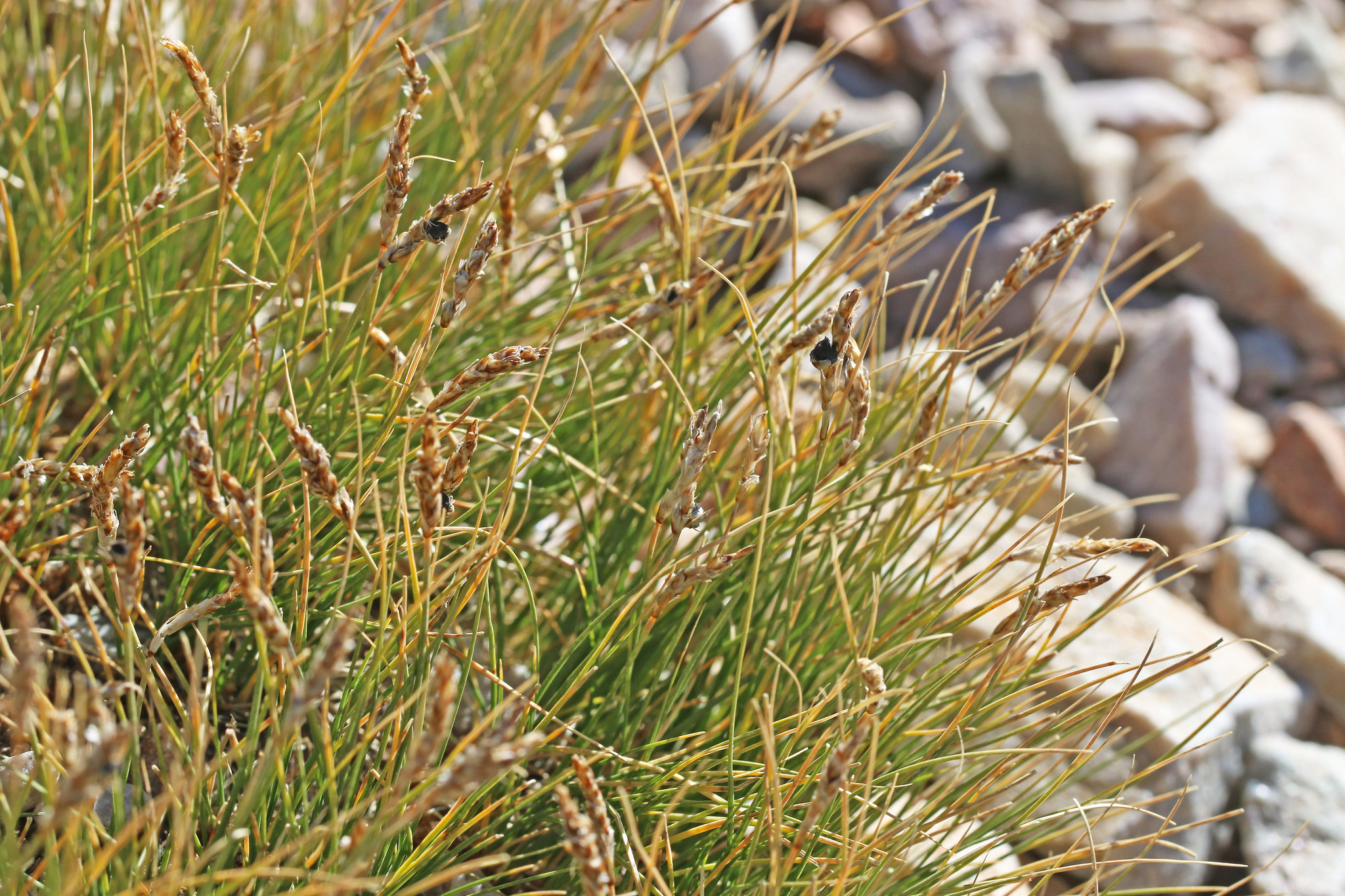
- 7. Perigynia glabrous or with only a very few inconspicuous short hairs near the beak; alpine species, from SW Montana to Colorado, W to Utah and Nevada. Carex elynoides
 |
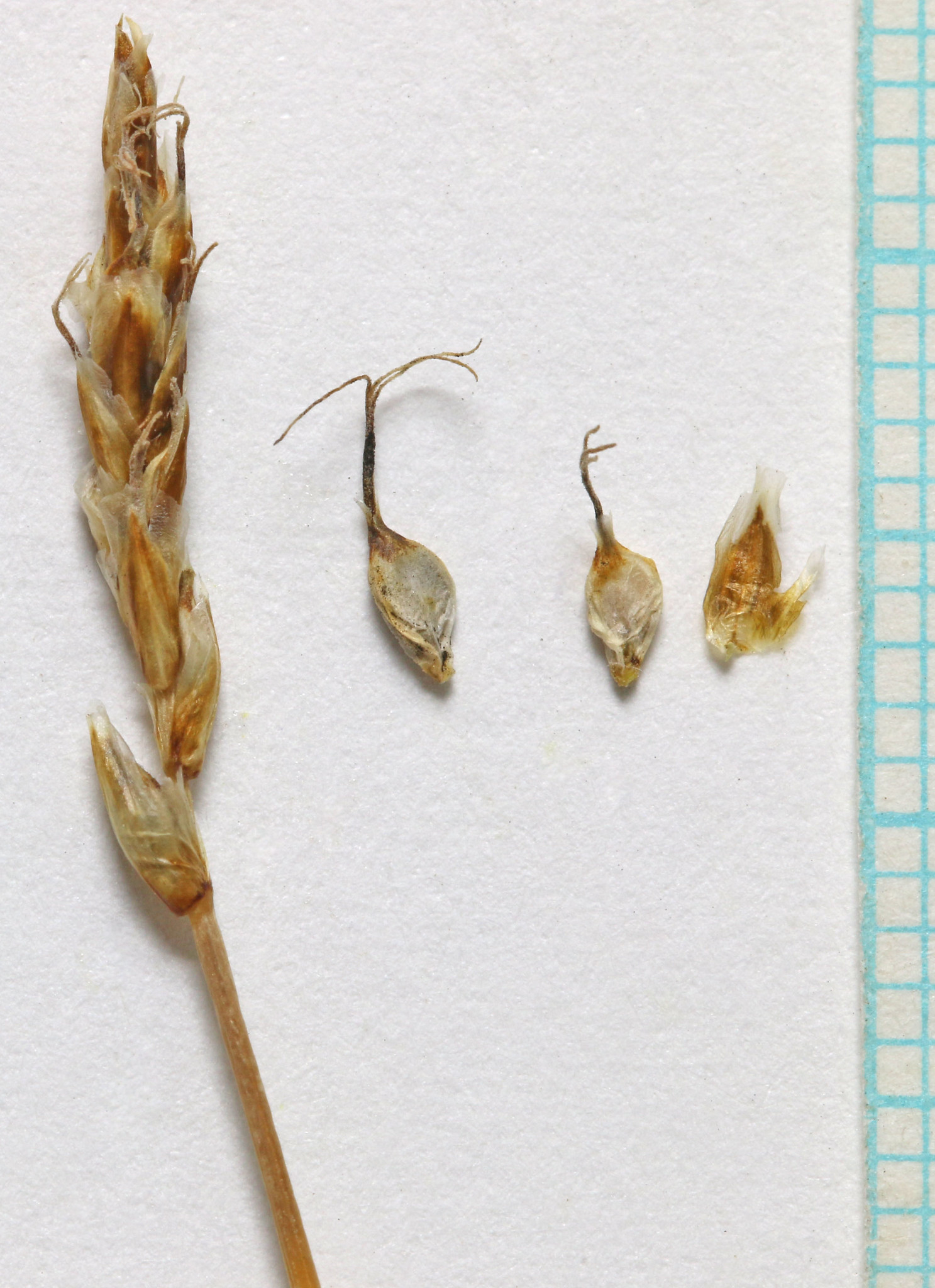 |
| Carex elynoides |
Carex elynoides |
- 7' Perigynia finely short-hairy, at least above the middle.
- 8. Perigynium with a definite short beak mostly 0.2-0.5 mm long; pistillate scales mostly about equalling the mature perigynia; dryland species, seldom at high elevations in the mountains; widespread, but not extending to California. Carex filifolia
 |
 |
 |
| Carex filifolia |
Carex filifolia |
Carex filifolia |
- 8' Perigynium essentially beakless; pistillate scales mostly distinctly shorter than the mature perigynia; montane species of California, extending into adjacent Oregon and Nevada. Carex exserta
- 4' Plants not densely tufted, the stems arising singly or few together from long, creeping rhizomes; stigmas 3.
- 9. Perigynia thin-walled, not at all coriaceous, mostly rather numerous, (5)-10-40 or more; alpine species (Inflatae).
- 10. Perigynius relatively large, (4)-4.5-7.5 mm long, much larger than the achene; spike stout, commonly 6-12 mm wide and 1.2-2.5 times as long as wide. Carex breweri var. paddoensis = Carex engelmannii
 |
 |
| Carex engelmannii |
Carex engelmannii |
- 10' Perigynium smaller, 2.5-3.5-(4) mm long, somewhat (but not very conspicuously) larger than the achene; spike more slender, commonly 4-6 mm wide and 2.5-3 times as long as wide. Carex subnigricans
 |
 |
| Carex subnigricans |
Carex subnigricans |
- 9' Perigynia thick-walled and coriaceous, few, mostly 1-6; dryland species (Obtusatae). Carex obtusata
 |
 |
| Carex obtusata |
Carex obtusata |
- 3' Rachilla obsolete; leaves various.
- 11. Pistilate scales decidious as the perigynia approach maturity, the perigynia becoming spreading or reflexed (Callistachys).
- 12. Plants densely cespitose, without evident rhizomes; leaves slender, 0.5-1.5 mm wide. Carex pyrenaica
 |
 |
 |
| Carex pyrenaica |
Carex pyrenaica |
Carex pyrenaica |
- 12' Plants evidently rhizomatous, only loosely or not at all cespitose; leaves wider, mostly (1)-1.5-3 mm wide. Carex nigricans
 |
 |
 |
| Carex nigricans |
Carex nigricans |
Carex nigricans |
- 11' Pistilate scales persistent, the perigynia widely spreading, or more appressed.
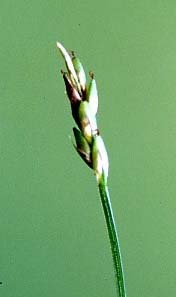
- 13. Perigynia rounded or emarginate at the tip, not at all beaked (Polytrichoidea). Carex leptalea
 |
 |
 |
 |
| Carex leptalea |
Carex leptalea |
Carex leptalea |
Carex leptalea |
- 13' Perigynia more or less distinctly (though often only shortly) beaked.
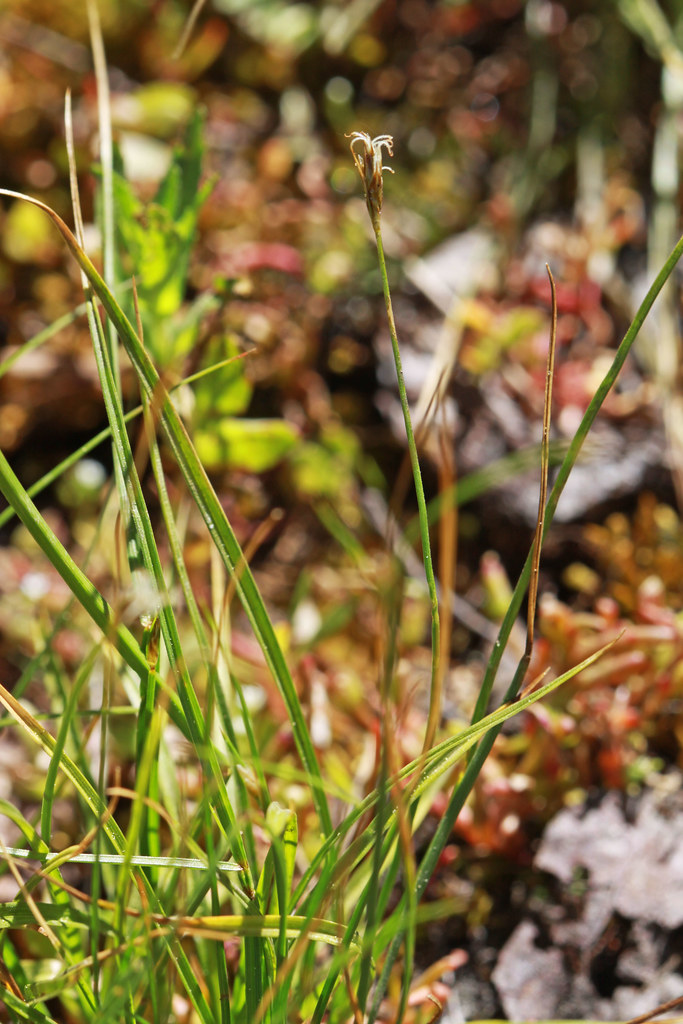
- 14. Stigmas 2; rhizomes very slender; perigynia soon becoming widely spreading (Dioicae). Carex gynocrates = Carex dioica
 |
 |
 |
| Carex gynocrates |
Carex gynocrates |
Carex gynocrates |
- 14' Stigmas normally 3, seldom only 2; rhizomes stouter; perigynia more or less appressed or ascending.
- 15. Spikes nearly or quite unisexual; perigynia mostly rather numerous, at least more than 15.
- 16. Perigynia evidently pubescent; mostly at high altitudes in the mountains. (Scirpinae)
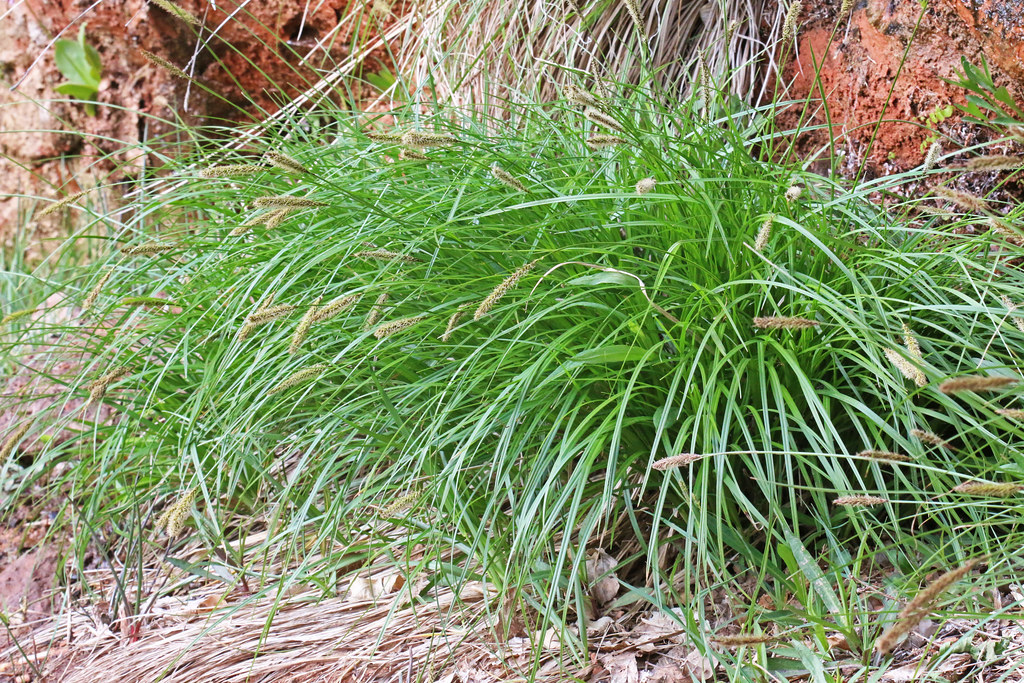
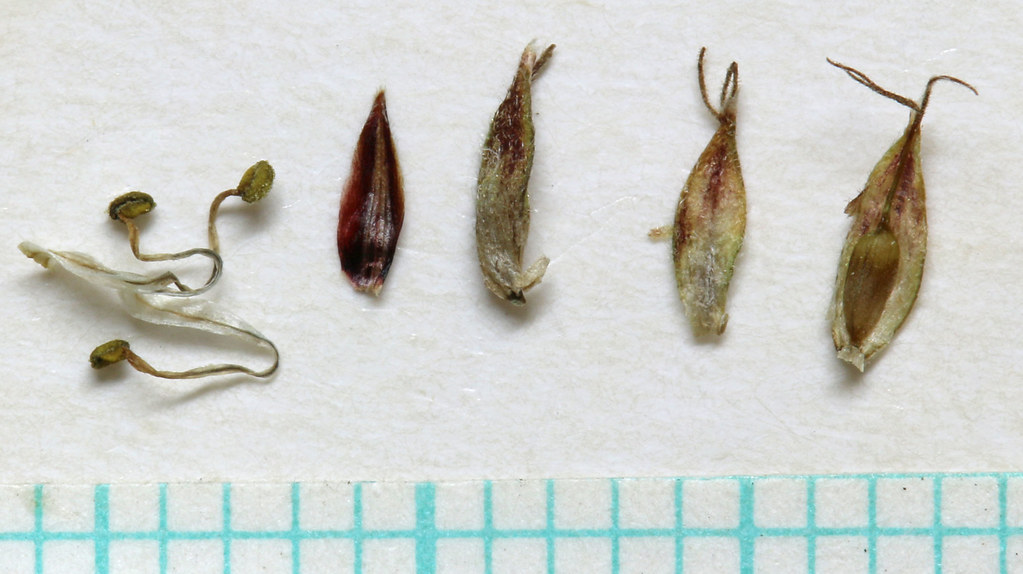
- 16.1. Pistillate scales tending to be narrower and shorter than the perigynia, so that much of the perigynium is exposed; plants relatively robust, phyllopodic to strongly aphyllopodic, 2.5-8 dm tall, with spikes mostly 2.5-5 cm long, one or two short spikes in addition to the terminal one frequently present; Kaibab Plateae north to hanging gardens at the junction of the San Juan and Colorado rivers; Uintah, Grand, Emery, San Juan, Garfield, Kane, Iron, Washington counties. Carex curatorum = Carex scirpoidea var. curatorum
 |
 |
 |
| Carex curatorum |
Carex curatorum |
Carex curatorum |
- 16.1' Pistillate scales usually about as long and wide as the perigynia, seldom distinctly narrower or shorter or both; plants phyllopodic, mostly less robust, 1-4-(5) dm tall, only occasionally with more than one spike; widespread at high altitudes (and in an unusual, highly alkaline habitats at 1830 m [6000 ft] at Monte Neva Hot Springs, White Pine county, Nevada), but not known from Arizona; Uintah, La Sal Mts. Carex scirpoidea ssp. pseudoscirpoidea
- 16.2' Plants not cespitose; rhizomes long; sheaths and bases of previous year’s leaves persistent. Carex scirpoidea ssp. pseudoscirpoidea
 |
 |
 |
| Carex scirpoidea var. pseudoscirpoidea |
Carex scirpoidea var. pseudoscirpoidea |
Carex scirpoidea var. pseudoscirpoidea |
- 16.2' Plants cespitose; rhizomes short or inconspicuous; sheaths or bases of previous year’s leaves absent. Carex scirpoidea ssp. scirpoidea
 |
 |
| Carex scirpoidea ssp. scirpoidea |
Carex scirpoidea ssp. scirpoidea |
- 16' Perigynia glabrous or nearly so; lowland to moderate elevations in the mountains; Cache, Utah, Wasatch, Juab, Sanpete, Emery, San Juan counties. (Atratae, pro min. parte) Carex parryana
 |
| Carex parryana |
- 15' Spikes evidently androgynous; perigynia mostly 5-15, glabrous; high altitudes in the mountains (Rupestres). (C. pyrenaica might sometimes be sought here, but has more numerous perigynia) Carex rupestris
 |
 |
| Carex rupestris |
Carex rupestris |
Group 2
- 1. Sheaths distinctly short-hairy, at least on the ventral surface; style straight; perigynia glabrous or hairy. (Paludosae)
 |
| Sheaths hairy in Carex sp. |
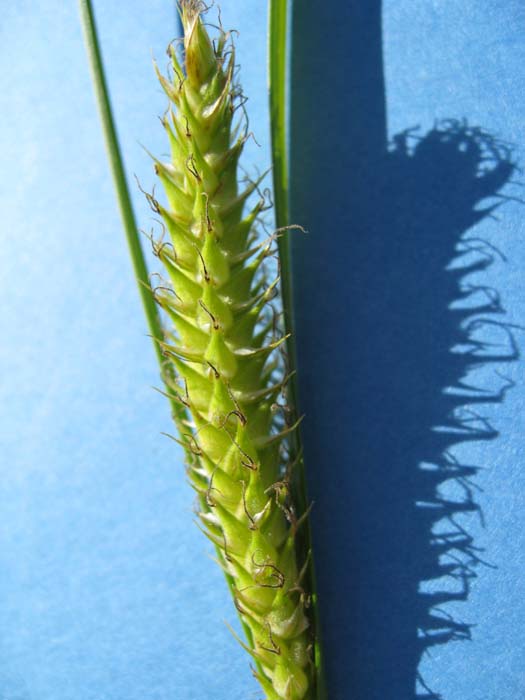
- 2. Perigynia short-hairy, 5-8 mm long, the teeth (0.5)-1.0-1.5 mm long; Summit county. Carex sheldonii
 |
 |
| Carex sheldonii |
Carex sheldonii |
- 2' Perigynia glabrous, 7-10 mm long, the teeth 1.5-2.5-(3) mm long; Utah and Sevier counties. Carex atherodes
 |
 |
 |
| Carex atherodes |
Carex atherodes |
Carex atherodes |
- 1' Sheaths and perigynia glabrous; style generally becoming flexuosus or contorted as the achene matures.
- 3. Stigmas usually 2 and achenes lenticular, seldom 3 and achenes trigonous; perigynia with 2 marginal nerves only, or with a few faint additional nerves on the dorsal surface, scarsely inflated, the achene filling the lower 2/3 or 3/4 of the body; Summit, Wasatch, Duchesne, Uintah, Sevier, Garfield, Kane counties. (Vesicariae) Carex saxatilis
 |
 |
| Carex saxatilis |
Carex saxatilis |
- 3' Stigmas 3 and achenes trigonous; perigynia evidently several- to many-nerved, scarsely to strongly inflated, the achene loose in the lower half of the body.
- 4. Pistillate spikes (at least the lower ones) more or less nodding on slender peduncles; pistillate scales with a short, largely scarious or hyaline body only 1-2 mm long and a firm awn 2-6 mm long; perigynia lanceolate or lance-ovate, not much inflated, strongly (12)-15-20-nerved, 5-7 mm long; Uintah, Carbon, Grand, San Juan, Garfield, Kane, Washington counties. (Pseudocyperae). Carex hystricina = Carex hystericina
 |
 |
| Carex hystricina |
Carex hystricina |
- 4' Pistillate spikes erect or stiffly ascending, subsessile or (especially the lowest) slender-pedunculate but still more or less erect; pistillate scales and perigynia otherwise, the perigynia distinctly inflated (Vesicariae).
- 5. Perigynia ascending, lanceolate to lance-ovate, tapering gradually to the often poorly defined beak; inflorescence loose as in C. rostrata; stems more or less clustered on rather short rhizomes. Carex vesicaria
 |
 |
| Carex vesicaria |
Carex vesicaria |
- 5' Perigynia more or less strongly spreading at maturity (or the lowest ones reflexed), the body ellipsoid or ovoid to subglobose, more or less abruptly contracted to the conspicuous beak.
- 6. Leafy bract subtending the lowest spike 1-2 times as long as the whole inflorescence, the inflorescence more or less elongate and the spikes remote; perigynia 4-7 mm long; plants sod-forming, the stems arising singly or few together from long rhizomes. Carex utriculata = Carex rostrata var. utriculata
 |
 |
 |
| Carex utriculata |
Carex utriculata |
Carex utriculata |
- 6' Leafy bract subtending the lowest spike 2-several times as long as the whole inflorescence, the spikes crowded, or only the lowest one remote; perigynia 7-10 mm long; plants densely tufted from a very short rhizome; Weber, Wasatch, Utah counties. Carex retrorsa
 |
 |
| Carex retrorsa |
Carex retrorsa |
Group 3
- 1. Achene filling the body of the perigynium; spikes all short, the pistillate ones up to about 10 mm and the staminate ones to about 15 mm long; some of the pistillate spikes basal or nearly so. (Montanae)
- 2. Soft-leaved, lax plants, (0.5)-1-3-(4) dm tall, of the coniferous forest zones; bract subtending the lowest nonbasal pistillate spike surpassing the staminate spike; widespread cordilleran species. Carex rossii
 |
 |
 |
| Carex rossii |
Carex rossii |
Carex rossii |
- 2' Firm-leaves, low plants of the pinyon-juniper and chaparral zones, not over 1 dm tall; bract subtending the lowest nonbasal pistillate spike seldom surpassing the staminate spike; C Utah and SW Colorado, to Arizona and N.M. Carex geophila
 |
| Carex geophila |
- 1' Achene loose in the perigynium, the upper part of the perigynium empty; spikes mostly longer, commonly 1-5 cm long, none of them near-basal.
- 3. Perigynium densely velvety or velvety-sericeous, thick-walled and more or less turgid, not strongly compressed; bract subtending the lowest pistillate spike with short (to 1 cm) or no sheath and with an elongate blade commonly more than 8 cm long and very often surpassing the inflorescence; rhizomatous, strongly aphyllopodic plants, not tufted (Hirtae). Carex lasiocarpa = Carex lanuginosa
- 3.1. Leaves involute or folded at least distally, often appearing terete, 1-1.5-(2) mm wide; plants of pond and marshes on subalpine moraines in E Uinta Mts. Carex lasiocarpa = Carex lanuginosa
 |
 |
 |
| Carex lasiocarpa |
Carex lasiocarpa |
Carex lasiocarpa |
- 3.1' Leaves flat or nearly so, the larger ones commonly 2-6 mm wide; plants widespread in the state. Carex pellita
 |
 |
 |
| Carex pellita |
Carex pellita |
Carex pellita |
- 3' Perigynium only sparsely and inconspicuously hirtellous, except for the serrulate beak and distal margins, thin-walled, more or less strongly compressed, not turgid; bract subtending the lowest pistillate spike with a well developed (1-4.5 cm) sheath and a short (1-8 cm) blade which is much surpassed by the inflorescence; plants tufted, not strongly aphyllopodic; Salt Lake, Beaver, Piute counties. (Ferrugineae). Carex luzulina
 |
 |
| Carex luzulina |
Carex luzulina |
Group 4
- 1. Lower pistillate scales much enlarged and leaflike, commonly 2-7 cm long; achene about 3 mm long, without a stylar apiculus (Phyllostachyae). Carex cordillerana
 |
 |
| Carex cordillerana |
Carex cordillerana |
- 1' Lower pistillate scales much smaller and not at all leaflike, seldom as much as 1 cm long; achene usually smaller and with a stylar apiculus.
- 2. Bracts subtending the spikes (or at least the bract subtending the lowest spike) with a well developed sheath, this usually at least 5 mm long.
- 3. Perigynia distinctly compressed, narrow, lanceolate or lance-ovate, usually ciliolate-serrulate on the margins distally (Ferrugineae).
- 4. Terminal spike staminate or androgynous; leaves 3-9 mm wide; montane but scarsely ; Salt Lake, Beaver, Piute counties. Carex luzulina
|
| Carex luzulina |
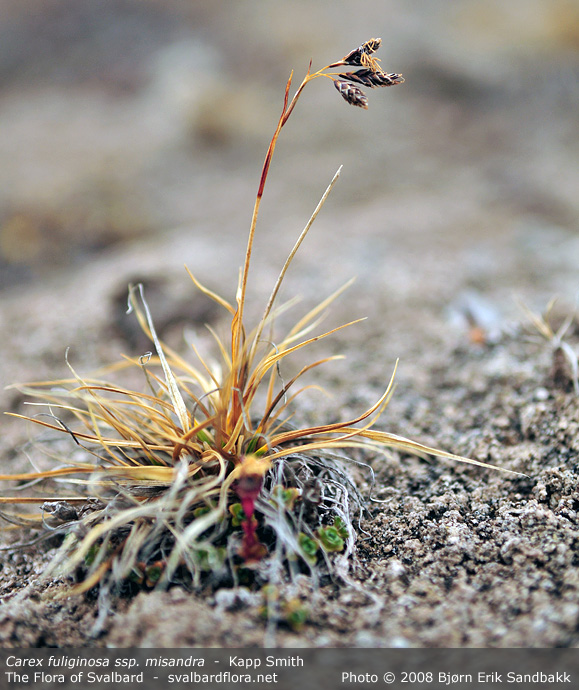
- 4' Terminal spike gynaecandrous, or sometimes wholly pistillate; leaves 1-3-(4) mm wide; arctic-alpine; Summit, Duchesne, Uintah counties.. Carex misandra
 |
 |
| Carex misandra |
Carex misandra |
- 3' Perigynia scarsely or not at all compressed, variously shaped, not ciliolate-serrulate.
- 5. None of the bracts conspicuously surpassing the inflorescence; all of the pistillate spikes, or all but the uppermost one subtended by conspicuously sheathing bracts; perigynia short-beaked or beakless.
- 6. Culms densely tufted; lateral spikes on lax, capillary, nodding or loosely spreading peduncles; perigynium essentially nerveless except for the 2 marginal nerves; Cache, Juab, Utah, Duchesne, Daggett, Uintah, Beaver, Iron, San Juan counties. (Capillares). Carex capillaris
 |
 |
 |
| Carex capillaris |
Carex capillaris |
Carex capillaris |
- 6' Culms arising singly or few together from creeping rhizomes; spikes all erect, short-pedunculate, or the lowest ones long-peduncled; perigynium nore or less evidently 15- to 25-nerved; Kane county. (Granulares). Carex crawei
 |
 |
| Carex crawei |
Carex crawei |
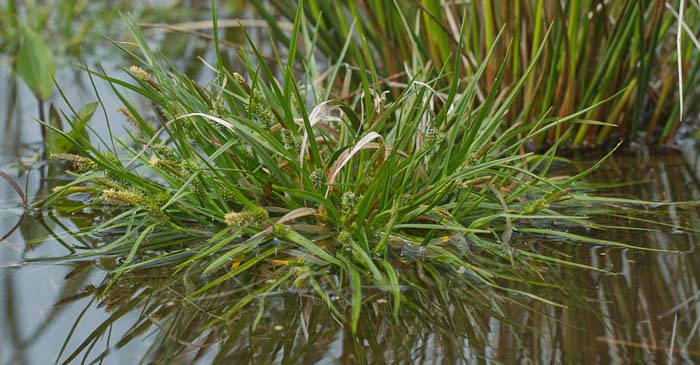
- 5' One or more of the bracts elongate and conspicuously surpassing the inflorescence; sheathing base present only on those bracts which subtend the 1 or 2 pistilate spikes (if any) that are remote from the terminal cluster of spikes; perigynia crowded, widely spreading or reflexed, prominently beaked; Summit, Duchesne, Uintah, Garfield, Kane counties. (Extensae). Carex viridula ssp. viridula = Carex oederi
 |
 |
| Carex oederi |
Carex oederi |
- 2' Bracts subtending the spikes all sheathless or nearly so.
- 7. Perigynium with a conspicuous beak 0.8-1.2 mm long.
- 8. Stems 1-4 dm tall, clustered, without rhizomes; leaves narrow, mostly 1-3 mm wide; Summit, Duchesne, Uintah, Garfield, Kane counties. (Extensae). Carex viridula ssp. viridula = Carex oederi
|
|
 |
| Carex oederi |
Carex oederi |
Carex oederi |
- 8' Stems 5-10 dm tall, from creeping rhizomes; leaves very broad, mostly 8-20 mm wide (Anomalae) Carex amplifolia
 |
 |
 |
| Carex amplifolia |
Carex amplifolia |
Carex amplifolia |
- 7' Perigynium beakless, or with a short beak up to about 0.6 mm long.
- 9. Roots covered with a yellowish-brown felt; lateral spikes all nodding on slender peduncles; perigynia densely and conspicuously papillate; species of Sphagnum bogs (Limosae).
- 10. Plants strongly aphyllopodic; leaves tending to be canaliculate; pistillate spikes 1-2.5 cm long; sometimes with a few staminate flowers at the tip, never at the base; Summit, Duchesne, Uintah counties. Carex limosa
 |
 |
| Carex limosa |
Carex limosa |
- 10' Plants phyllopodic and with the old leaves more or less persistent at the base; leaves flat; pistillate spikes 0.7-1.5 cm long, often with a few staminate flowers at the base, never at the tip; Wasatch, Summit, Duchesne, Uintah counties. Carex magellanica ssp. irrigua = Carex paupercula ssp. irrigua
 |
 |
 |
| Carex paupercula |
Carex paupercula |
Carex paupercula |
- 9' Roots glabrous or inconspicuously hairy, not felty-tomentose; lateral spikes sessile or pedunculate, erect to nodding; perigynia in most species (with the notable exception of C. buxbaumi) not strongly papillate, although the cellular reticulum is sometimes readily visible; plants not of Sphagnum bogs (Atratae).
- 11. Terminal spike staminate or androgynous; bisexual spikes, if any, always androgynous.
- 12. Perigynia small, only 1.9-3.0 mm long; achene 1.4-1.8 mm long, only slightly smaller than the peigynial cavity; spikes all erect or closely ascending; Cache, Utah, Wasatch, Juab, Sanpete, Emery, San Juan counties. Carex parryana
 |
 |
 |
| Carex parryana |
Carex parryana |
Carex parryana |
- 12' Perigynia larger, mostly 3.0-5.5 mm long; achenes either at least 2.0 mm long, or notably smaller than the perigynial cavity; lateral spikes erect or nodding.
- 13. Perigynium somewhat inflated, its marginal nerves not displaced; N and C Utah. Carex raynoldsii
 |
 |
| Carex raynoldsii |
Carex raynoldsii |
- 13' Perigynium strongly flattened, though often distended around the achene, its "marginal" nerves displaced so as to be distinctly inframarginal on the abaxial side. Carex paysonis
 |
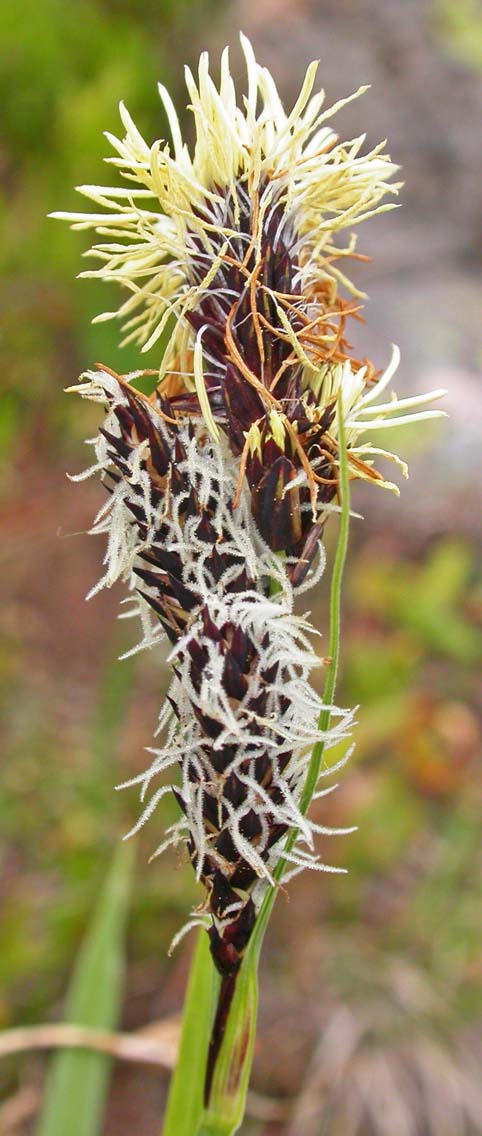 |
| Carex paysonis |
Carex paysonis |
- 11' Terminal spike gynaecandrous, or in C. parryana often wholly pistillate or with more or less intermingled male and female flowers; bisexual spikes never androgynous.
- 14. Plants producing elongate rhizomes; stems of the season strongly aphyllopodic and arising singly or few together, not surrounded by the dried sheaths of previous years; perigynia densely and conspicuously papillate; boreal species of wet places. Carex buxbaumii
 |
| Carex buxbaumii |
- 14' Plants without long rhizomes; stem of the season clustered and surrounded by the dried sheaths of previous years; perigynia moderately to not at all papillate.
- 15. Perigynia small, mostly only 1.9-3.0 mm long; spikes more or less approximate (but not capitate-crowded), erect or closely ascending.
- 16. Spikes relatively short, the terminal one 6-14 mm long; pistillate scales very dark, blackish-purple or brownish-black; montane. Carex stevenii = Carex norvegica var. stevenii
 |
 |
| Carex stevenii |
Carex stevenii |
- 16' Spikes longer, the terminal one (10)-15-30 mm long; pistillate scales brown or stramineous, not at all blackish; valleys and foothills; Cache, Utah, Wasatch, Juab, Sanpete, Emery, San Juan counties. Carex parryana
|
|
|
| Carex parryana |
Carex parryana |
Carex parryana |
- 15' Perigynia larger, mostly 3.0-5.5 mm long (or as little as 2.7 mm in species with capitate inflorescence or nodding spikes).
- 17. Spikes more or less closely aggregated into a dense head; plants strictly alpine and subalpine.
- 18. Spikes all sessile or very nearly so and very closely crowded, the lateral ones rather widely ascending or spreading; achenes tending to be stipitate; pistillate scales about equaling the perigynis, only very narrowly and obscurely hyaline-margined, or marginless; plants (1)-2-6 dm tall.
- 18.1. Perigynia 1.1–1.8 mm wide, usually somewhat inflated, without flattened margins or these generally not conspicuous, nearly filled by the mature achene, papillate at least apically (use 20x or greater magnification). Carex nelsonii
- 18.1' Perigynia 2–3 mm wide, strongly flattened with conspicuous broad margins, wider than the mature achene, more or less glossy on the faces, smooth or sometimes ciliolate apically. Carex nova
 |
 |
 |
| Carex nova |
Carex nova |
Carex nova |
- 18' Spikes a little less densely crowded, more closely ascending, the lowest one often short-pedunculate; achenes sessile or nearly so; plants 1-3 dm tall.
- 19. Pistillate scales narrow and elongate, evidently surpassing the perigynia but leaving the margins exposed, the scales not evidently hyaline-margined; California and adjacent Nevada. Carex helleri
 |
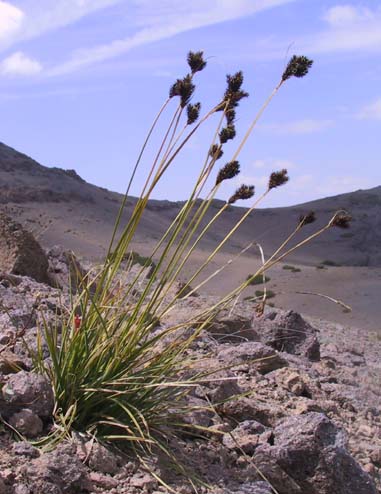 |
| Carex helleri |
Carex helleri |
- 19' Pistillate scales shorter and broader, scarsely it at all exceeding the perigynia and not obviously narrower than the perigynia, usually conspicuously hyaline-margined; more eastern species. Carex albonigra
 |
 |
 |
| Carex albonigra |
Carex albonigra |
Carex albonigra |
- 17' Spikes more or less approximate, but not closely aggregated into a dense head; plants 1.5-8 dm tall, montane or submontane to alpine.
- 20. Spikes tending to be erect or stiffly ascending (or the whole inflorescence sometimes nodding), not individually nodding; achene relatively small, 1.2-1.8 mm long, reaching only to within 0.6-1.5 mm of the tip of the perigynial cavity; widespread in the mountains. Carex heteroneura = Carex atrata
- 20.1. Pistilate scales equal to or longer than the perigynia; plants mostly of S half of the state, but also in Wasatch Mts. Carex chalciolepis = Carex heteroneura var. chalciolepis
- 20.1' Pistillate scales equal to or shorter than the perigynia; plants rather widely distributed Carex epapillosa = Carex heteroneura var. epapillosa
 |
 |
| Carex atrata |
Carex atrata |
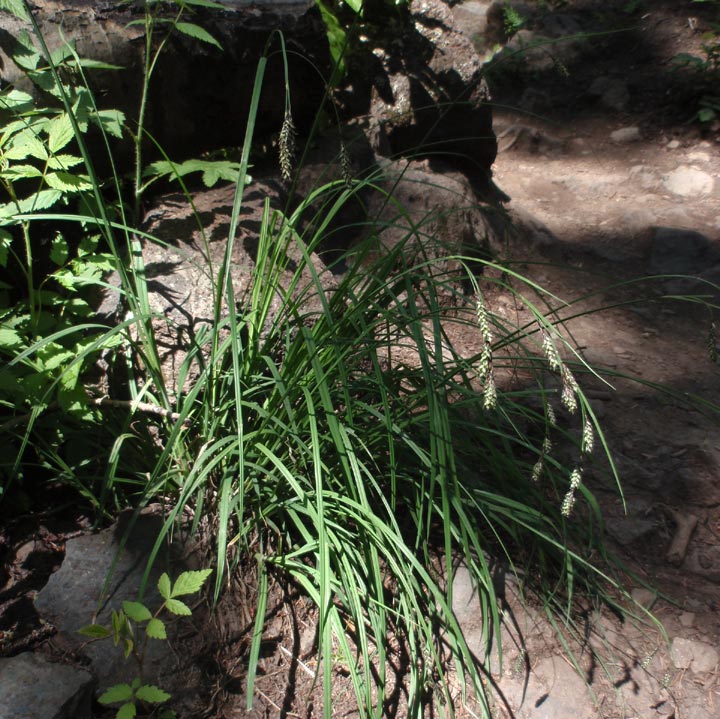
- 20' Spikes (at least the lower) individually more or less nodding; achene larger, 1.8-2.4 mm long, reaching to within 0.2-0.7 mm of the tip pf the perigynial cavity; southern species, extending N to C Utah and C Colorado. Carex bella
 |
 |
| Carex bella |
Carex bella |
Group 5
- 1. Bract subtending the lowest spike with a well developed sheath at the base; perigynia hardly at all compressed; plants small, not over 4 dm tall. (Bicilores) Carex aurea
 |
 |
| Carex aurea |
Carex aurea |
- 1' Bract subtending the lowest spike sheathless or nearly so; other characters various. (Acutae)
- 2. Perigynia evidently nerved on both faces as well as on the margins; lowest bract usually equalling or surpassing the terminal spike, seldom somewhat shorter.
- 3. Plants more or less densely tufted, without long rhizomes, the larger roots covered with yellowish or yellow-brown feltlike hairs; pistillate spikes 3-4 mm wide, perigynium membraneous, conspicuously stipitate, soon decidious after maturity, its beak entire; leaves relatively narrow, 1-2.6 mm, seldom over 4 mm wide. Carex lenticularis var. lipocarpa = Carex kelloggii
 |
 |
 |
 |
| Carex lenticularis |
Carex lenticularis |
Carex lenticularis |
Carex lenticularis |
- 3' Plants scarsely tufted, vigorously rhizomatous; perigynium coriaceous, its beak tending to be bidentate; leaves broader, the largest ones mostly (3)-4-10 mm wide. Carex nebrascensis
 |
 |
 |
| Carex nebrascensis |
Carex nebrascensis |
Carex nebrascensis |
- 2' Perigynia nerveless or nearly so on both faces, or occasionally some of them with one or two irregular nerves.
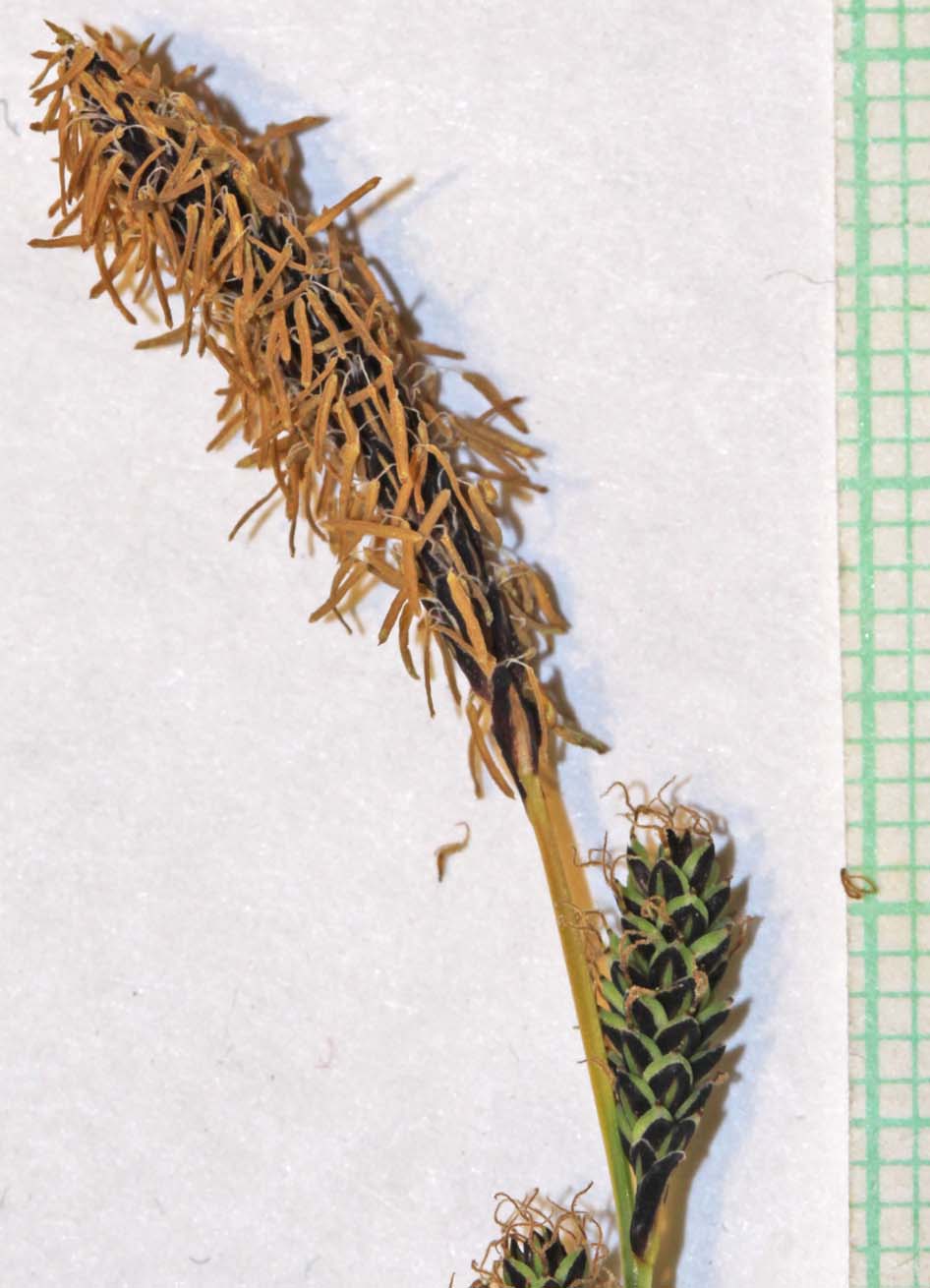
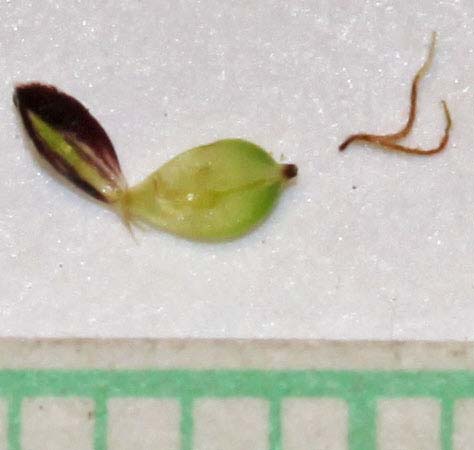
- 4. Lowest bract short, up to about 7 cm long, surpassed by the terminal spike; plants relatively low, mostly 1-4-(6) dm tall; in Deep Creek, Raft River and Uinta Mts: Box Elder, Summit, Daggett, Uintah, Juab counties. Carex scopulorum var. bracteosa
 |
 |
 |
| Carex scopulorum |
Carex scopulorum |
Carex scopulorum |
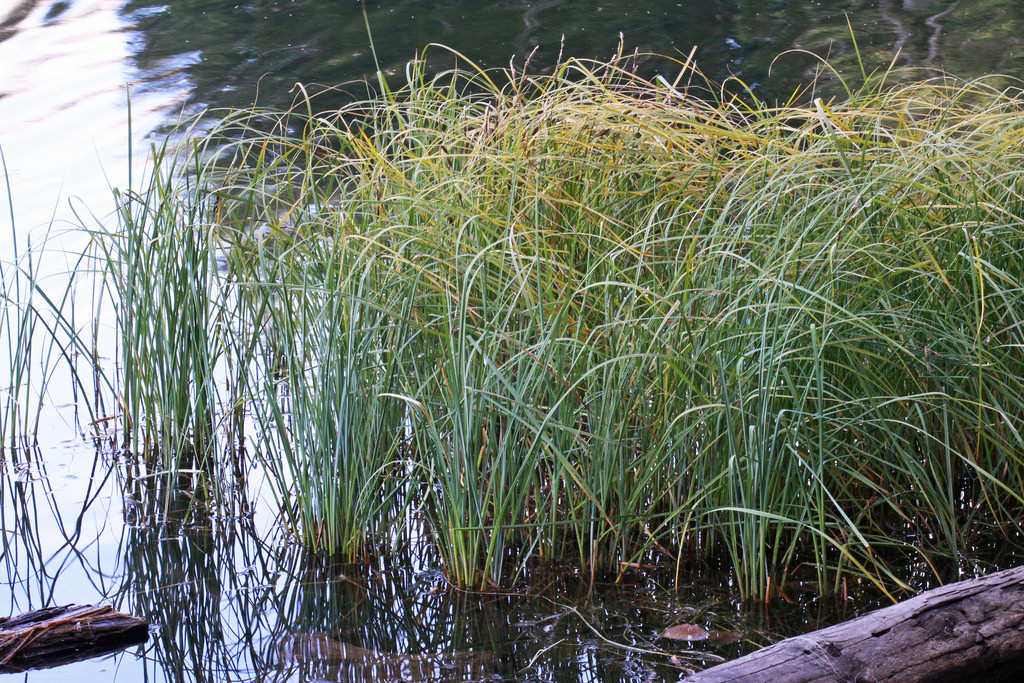
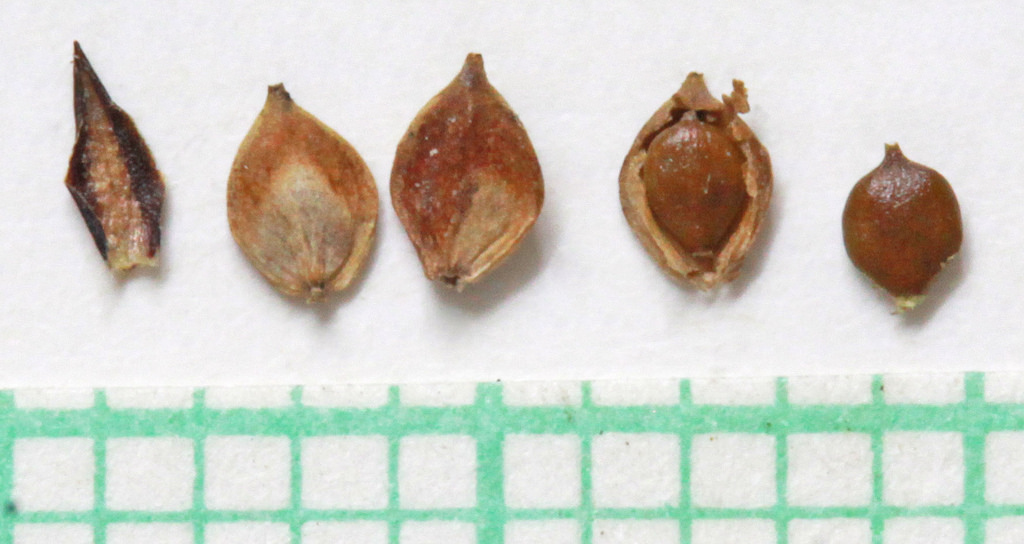
- 4' Lowest bract elongate, mostly 7-50 cm long, usually equaling or surpassing the terminal spike; plants taller, mostly 3-10-(15) dm tall. Carex aquatilis var. aquatilis
 |
 |
 |
 |
| Carex aquatilis |
Carex aquatilis |
Carex aquatilis |
Carex aquatilis |
Group 6
- 1. Plants rhizomatous, the culms arising singly or only loosely clustered.
- 2. Inflorescence interrupted-linear, the individual spikes mostly well separated from each other, very small and few-flowered, about 5 mm long or less, with mostly only 1-3 perigynia and about as many staminate flowers; soft, slender plants of swamps and streambanks (Heleonastes, pro parte). Carex disperma
 |
 |
 |
| Carex disperma |
Carex disperma |
Carex disperma |
- 2' Inflorescence more or less headlilke, though sometimes elongate, the individual spikes, or most of them, more or less closely aggregated, often more than 5 mm long and with more flowers than in C. disperma; various habitats, but seldom in swamps or along streambanks.
- 3. Spikes all very closely aggregated into a compact head, not individually distinguishable to the naked eye; dwarf, alpine and subalpine plants up to about 2.5 dm tall (Foetidae).
- 4. Perigynium relatively broad, mostly 1.9-2.6 mm wide and 1.5-2 times as long as wide, nearly or fully twice as wide as achene, not stipitate at the base; leaves narrow, commonly equalling or surpassing the culms, seldom at all shorter; above timberline in the S Rocky Mountains. Carex perglobosa
 |
 |
| Carex perglobosa |
Carex perglobosa |
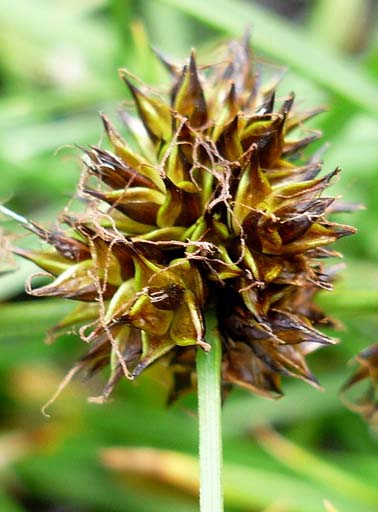
- 4' Perigynium narrower, mostly 1.0-1.6 mm wide and (2)-2.5-4.5 times as long as wide, not more than half again as wide as the achene, more or less strongly stipitate at the base; leaves wider, mostly 2-4 mm wide, shorter than the culms, irregularly distributed at high elevations, not necessarily above the timberlline, from Colorado to California and Washington. Carex vernacula = Carex foetida var. vernacula
 |
 |
| Carex foetida |
Carex foetida |
- 3' Spikes not so closely aggregated, the lower ones, at least, readily distinguishable to the naked eye; mostly taller plants of more moderate elevations.
- 5. Plants phyllopodic to slightly aphyllopodic, the leaves all clustered at or near the base; perigynia 1.7-4.3 mm long, essentially nerveless ventrally, often sharp-edged but not thin-margined (Divisae).
- 6. Perigynia very small, 1.7-2.5-(2.6) mm long, the beak 0.2-0.4-(0.6) mm long, the body very firm and thick-walled, especially proximally. Carex simulata
 |
 |
 |
| Carex simulata |
Carex simulata |
Carex simulata |
- 6' Perigynia larger, 2.6-4.3 mm long, the beak 0.5-1.5 mm long, the perigynial wall sometimes fairly firm but not especially thick.
- 7. Spikes at least ordinarily all unisexual and the plants dioecious; spikes mostly 10-15 mm long, the head mostly 1.5-4.5 cm long; perigynia 3.5-4.6 mm long, with a prominent beak mostly 1.0-1.5 mm long. Carex douglasii
 |
 |
| Carex douglasii |
Carex douglasii |
- 7' Spikes (or most of them) ordinarily androgynous, rarely all unisexual and the plants dioecious, the spikes, heads, and perigynia then smaller than in C. douglasii.
- 8. Rhizome slender, brownish; plants slender, 0.5-2 dm tall, with very narrow leaves only 0.3-1.5 mm wide; perigynia 2.6-3.3-(3.5) mm long. Carex duriuscula = Carex stenophylla
 |
 |
| Carex stenophylla |
Carex stenophylla |
- 8' Rhizome coarse, black or brownish black; plants (1)-3-7 dm tall, with leaves 1-3 mm wide; perigynia 2.9-3.8 mm long. Carex praegracilis
 |
 |
| Carex praegracilis |
Carex praegracilis |
- 5' Plants strongly aphyllopodic, the leaves not forming a basal cluster; perigynia 4.5-6.2 mm long, more or less evidently nerved ventrally, the body tending to be thin-margined distally (Arenariae). Carex siccata
 |
 |
 |
| Carex siccata |
Carex siccata |
Carex siccata |
- 1' Plants more or less densely tufted, with short or no creeping rhizomes.
- 9. Perigynia variously shaped (but not lance-triangular), generally broadest distinctly above the base, the body more or less abruptly tapering or contracted into a beak, which may also be of different texture from the body.
- 10. Spikes few, mostly 10 or less; sheaths not red-dotted (Bracteosae).
- 11. Body of the perigynium strongly planoconvex, broadly rounded on the convex side (the marginal nerves tending to appear ventromarginal), very abruptly contracted to the beak and wholly filled by the mature achene, not evidently serrulate-margined (except often on the beak) at 10X magnification; spikes loosely aggregated into an irregular, oblong-cylindric head. Carex vallicola
 |
 |
| Carex vallicola |
Carex vallicola |
- 11' Body of the perigynium moderately planoconvex (the marginal nerves only occasionally appearing ventromarginal), less abruptly contracted to the beak, the upper part not wholly filled by the achene, more or less evidently serrulate-margined above the middle.
- 12. Spikes loosely aggregated into an irregular or interrupted, oblong-cylindric to nearly linear head, at least the lower ones readily distinguishable to the naked eye; perigynia usually not so markedly bicolored as in C. hoodii. Carex occidentalis
 |
 |
| Carex occidentalis |
Carex occidentalis |
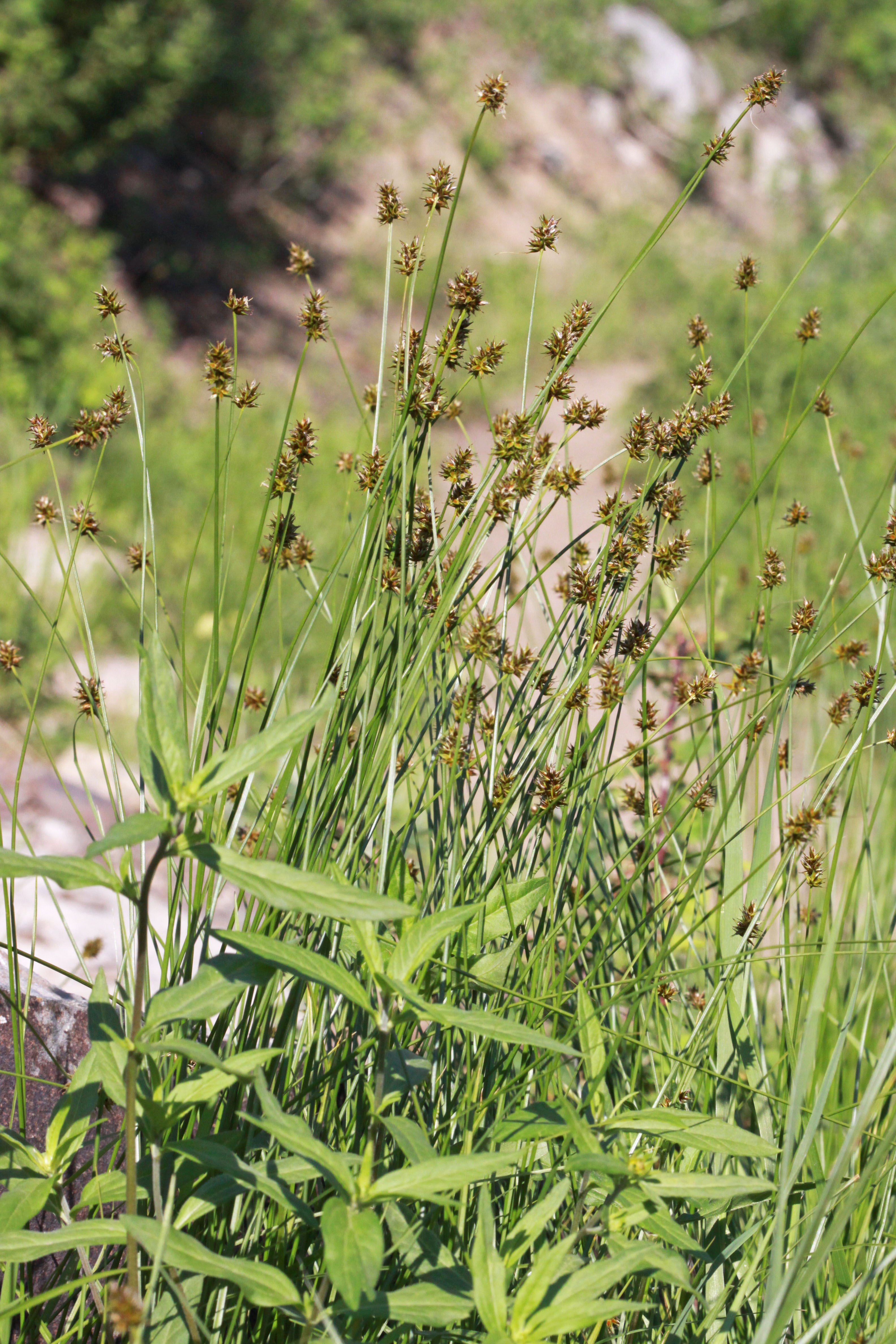
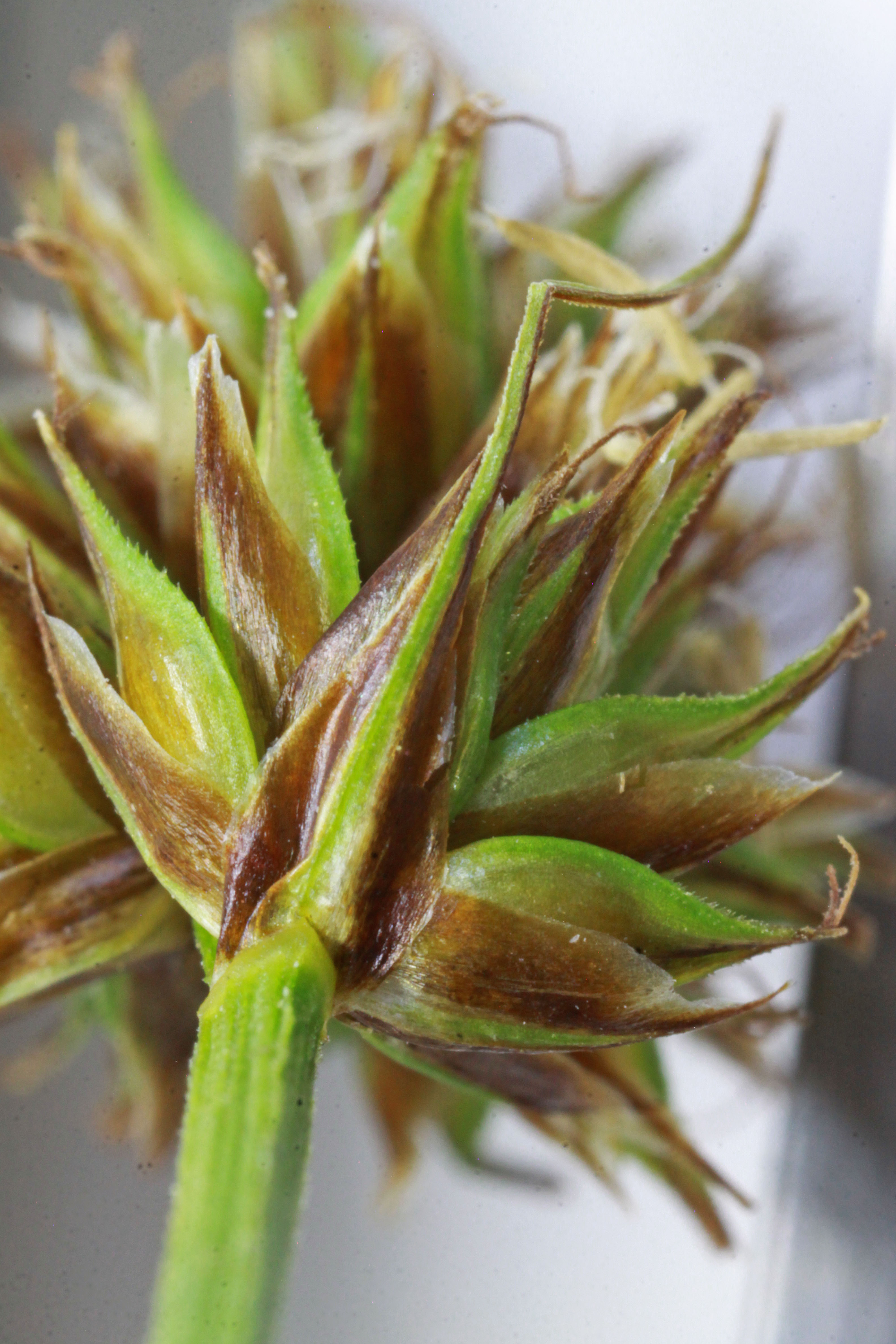
- 12' Spikes closely aggregated into a dense, oblong-cylindric to ovoid head, not readily distinguishable to the naked eye; perigynia tending to be coppery-brown except for the green or greenish margins. Carex hoodii
 |
 |
 |
| Carex hoodii |
Carex hoodii |
Carex hoodii |
- 10' Spikes more or less numerous (at least more than 10) in a usually compound inflorescence; sheaths somewhat red-dotted ventrally.
- 13. Midrib of the pistillate scale not excurrent, or excurrent only as a minute point not more than 0.5 mm long; sheaths not cross-rugose. (Paniculatae).
- 14. Perigynium very firm and thick-walled, the dorsal side with a median thin (often depressed and pale) strip that extends all the way to the base; inflorescence short, mostly 2-3.5-(5) cm long; circumboreal species, rare with us. Carex diandra
 |
| Carex diandra |
- 14' Perigynium rather thin-walled, lacking a median thinner strip; inflorescence more or less elongate, mostly 3-10 cm long; southwestern species, just entering the S part of our range in Nevada. Carex alma
 |
 |
| Carex alma |
Carex alma |
- 13' Midrib of the pistillate scale excurrent as a definite awn mostly 1-5 mm long; sheaths generally cross-rugose ventrally; low elevations. (Multiflorae). Carex vulpinoidea
 |
 |
 |
| Carex vulpinoidea |
Carex vulpinoidea |
Carex vulpinoidea |
- 9' Perigynia broadest at or near the base, commonly lance-triangular, tapering very gradually and evenly into the often ill-defined beak, or only slightly more abruptly contracted distally (Vulpinae).
- 15. Perigynia relatively large, (3.6)-4.0-5.2 mm long; leaves broad, the larger ones mostly 5-10 mm wide; inflorescence relatively large, (2)-3-10 cm long; sheaths generally cross-corrugated. Carex stipata
 |
 |
 |
| Carex stipata |
Carex stipata |
Carex stipata |
- 15' Perigynia smaller, mostly 2.9-3.8 mm long; leaves narrower, mostly 1-5 mm wide; inflorescence smaller, 0.8-2.5-(3) cm long; sheaths cross-corrugated or not.
- 16. Leaves clustered near the base; ventral surface of the sheath only seldom cross-corrugated, usually truncate or concave at the mouth and not cartilaginous-thickened, often hidden in the leaf-tuft. Carex jonesii
 |
 |
 |
| Carex jonesii |
Carex jonesii |
Carex jonesii |
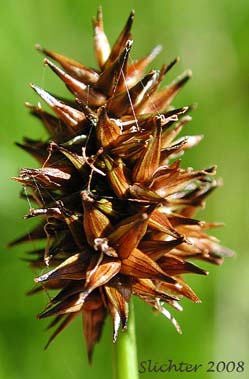
- 16' Leaves not closely clustered; ventral surface of at least some of the sheaths readily visible, usually cross-corrugated, tending to be convex or prolonged (and often cartilaginous) at the mouth. Carex neurophora
 |
 |
 |
| Carex neurophora |
Carex neurophora |
Carex neurophora |
Group 7
- 1. Perigynia ascending or ascending-spreading at maturity; (C. leporinella, of the section Ovales, might be sometimes be sought here).
- 2. Perigynium 1.7-3.4 mm long, short-beaked or nearly beakless, the beak often less than 0.5 mm long, less often ip to 1.0 mm, only inconspicuously or not at all serrulate-margined; leaves mostly 1-2.5 mm wide (to 3.5 mm in C. canescens); (Heleonastes, pro max. parte).
- 3. Spikes 2-4, all approximate; pistillate scales fully equaling the body of the perigynium, though sometimes minutely surpassed by the beak; perigynia mostly 2.4-3.4 mm long, with a prominent dorsal suture 0.7-1.5 mm; alpine plants, only 1-3 dm tall, rare in our range. Carex bipartita
 |
 |
| Carex bipartita |
Carex bipartita |
- 3' Spikes 4-8-(10), the lower ones (or all of them) often more or less remote; pistillate scales tending to be shorter than the body of the perigynium; perigynia mostly 1.7-2.5 mm long.
- 4. Spikes relatively small and few-flowered, with only 5-10-(15) perigynia; wall of the distal part of the perigynium-body very thin and easily ruptured; ventral surface of the perigynium nerveless or obscurely nerved; dorsal suture of the perigynium Prominent, extending the length of the beak-apiculation and encroaching onto the distal part of the body. Carex brunnescens
 |
 |
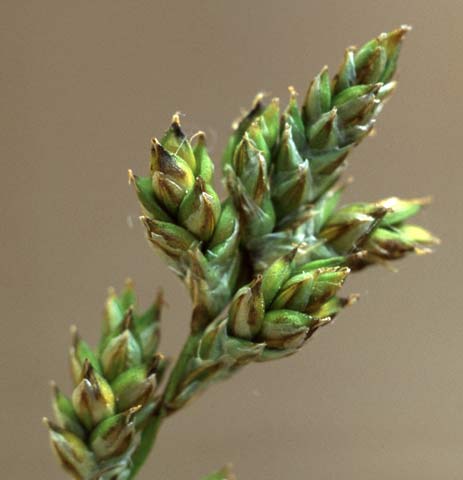 |
| Carex brunnescens |
Carex brunnescens |
Carex brunnescens |
- 4' Spikes larger and more numerously flowered, with mostly (10)-15-30 perigynia; wall of the distal part of the perigynium not especially thin and fragile; ventral surface of the perigynium evidently nerved.
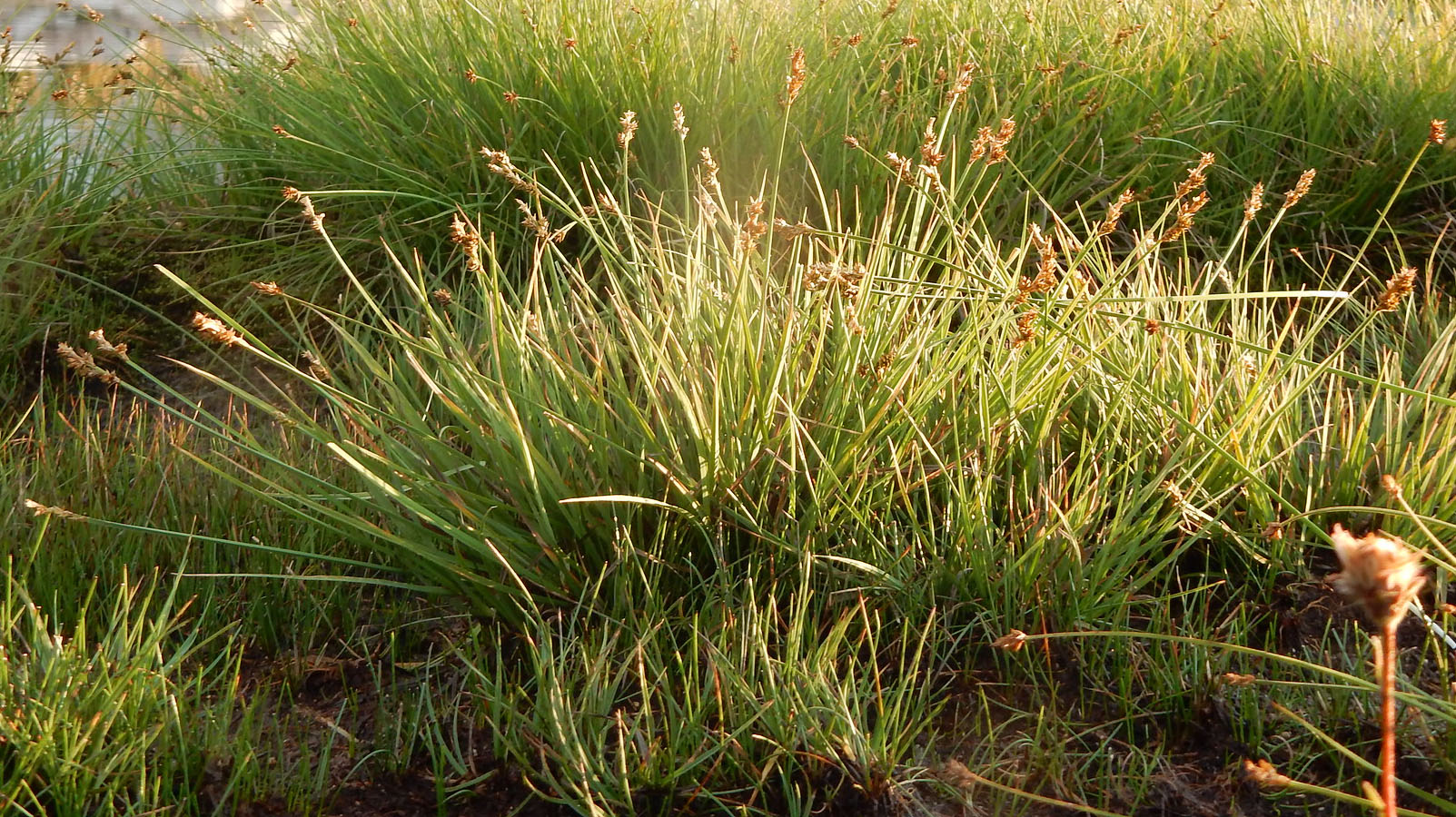
- 5. Spikes 4-6, brownish in aspect, all closely aggregated; dorsal suture usually extending the length of the beak-apiculation, but scarsely encroaching onto the body of the perigynium; plants 1-3 dm tall, occurring at high elevations in the mountains. Carex praeceptorum
 |
 |
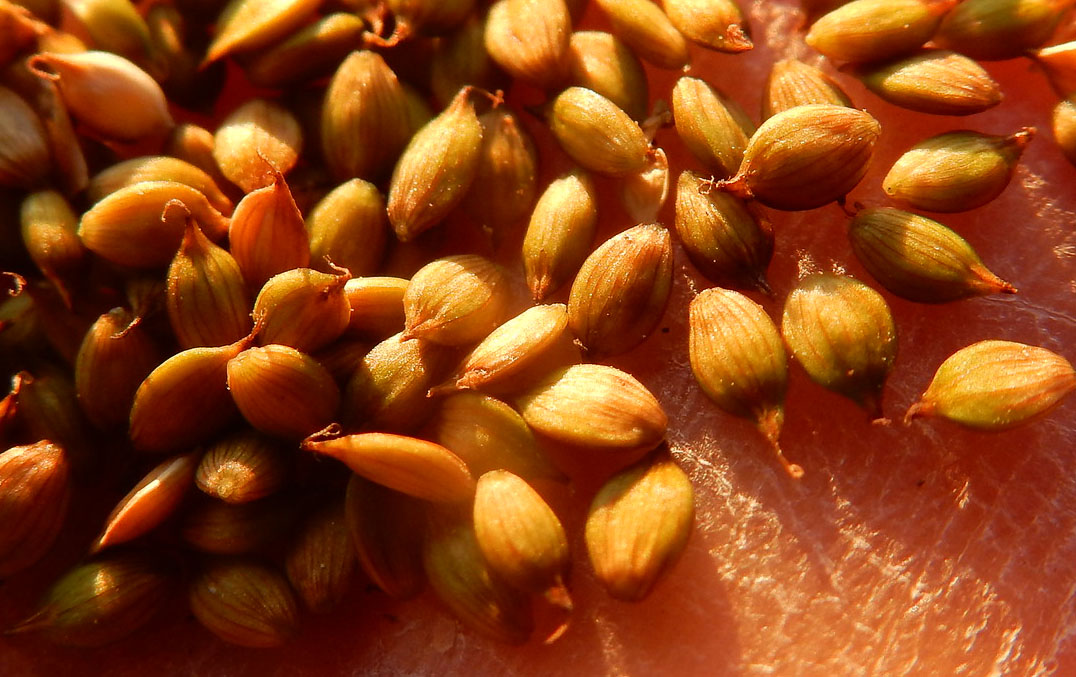 |
| Carex praeceptorum |
Carex praeceptorum |
Carex praeceptorum |
- 5' Spikes 4-8, silvery green to pale grayish or stramineous in aspect, the lower ones, at least, usually somewhat remote, so that the inflorescence is interrupted and not head-like; dorsal suture of the perigynium short and poorely developed, commonly restricted to the distal part of the beak-apiculation; plants of various altitudes, often over 3 dm tall. Carex canescens
 |
 |
 |
| Carex canescens |
Carex canescens |
Carex canescens |
- 2' Perigynium (3.1)-3.5-4.8 mm long, relatively long-beaked, the beak mostly (0.8)-1.1-1.9 mm long, and serrulate-margined; leaves mostly 2-5 mm wide; (Deweyanae). Carex deweyana
 |
 |
 |
| Carex deweyana |
Carex deweyana |
Carex deweyana |
- 1' Perigynia widely spreading at maturity, or the lower ones reflexed.
- 6. Perigynium more or less evidently serrulate on the beak (and often also on the distal part of the body) at 10x magnification (Stellulatae).
- 7. Beak of the perigynium short and stout, one fourth to one half as long as the body, up to about 1 mm long, only very shortly and inconspicuously bidentate; perigynia mostly 2.2-3.2 mm long. Carex interior
 |
 |
| Carex interior |
Carex interior |
- 7' Beak of the perigynium longer and relatively more slender, one half as long to almost as long as the body, mostly 1-2 mm long; perigynia mostly 2.8-3.5-(4.0) mm long. Carex echinata ssp. echinata = Carex muricata
 |
 |
| Carex muricata |
Carex muricata |
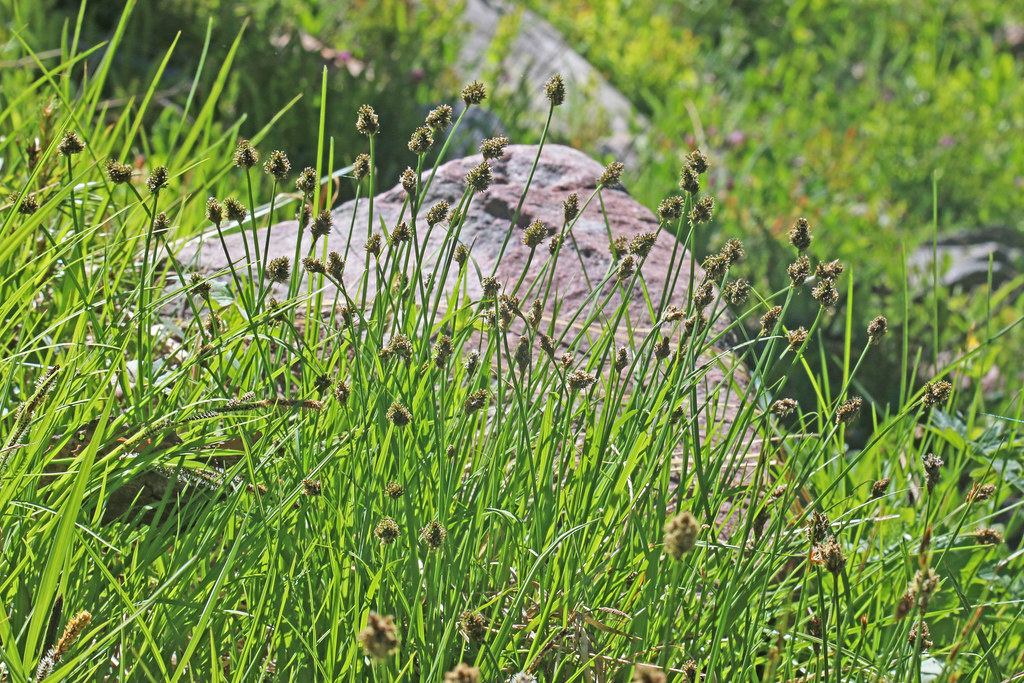
- 6' Perigynium strictly entire-margined, not serrulate on either the body or the beak, 2.5-3.2 mm long (Ovales, pro min. parte). Carex illota
 |
 |
 |
| Carex illota |
Carex illota |
Carex illota |
Group 8
- 1. Perigynia very small, only 2.5-3.2 mm long.
- 2. Margins of the perigynium sharp but neither winged nor serrulate; perigynia widely spreading (unique among our species of the section in this regards). Carex illota
|
|
|
| Carex illota |
Carex illota |
Carex illota |
- 2' Margins of the perigynium more or less winged or serrulate, at least toward the distal part of the body; perigynia more nearly appressed, at least not widely spreading.
- 3. Inflorescence small and compact, mostly 7-15 mm long, the spikes scarsely distinguishable to the naked eye; NW montane species, in our range known only from Elko County, Nevada. Carex limnophyla
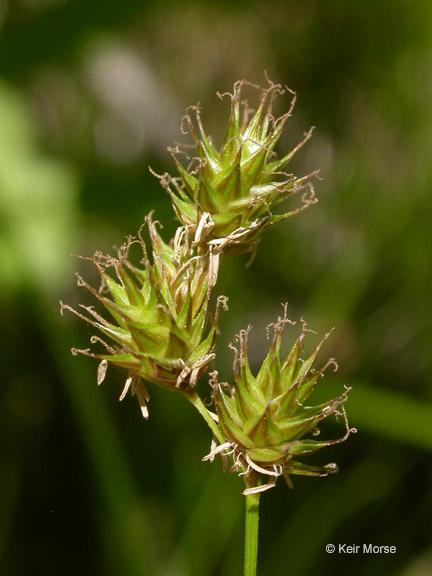
- 3' Inflorescence larger and looser, mostly 15-30 mm long, the spikes readily distinguishable to the naked eye; W and S species, in our range known only from S Utah (Sevier, Wayne, Washington counties). Carex subfusca
 |
 |
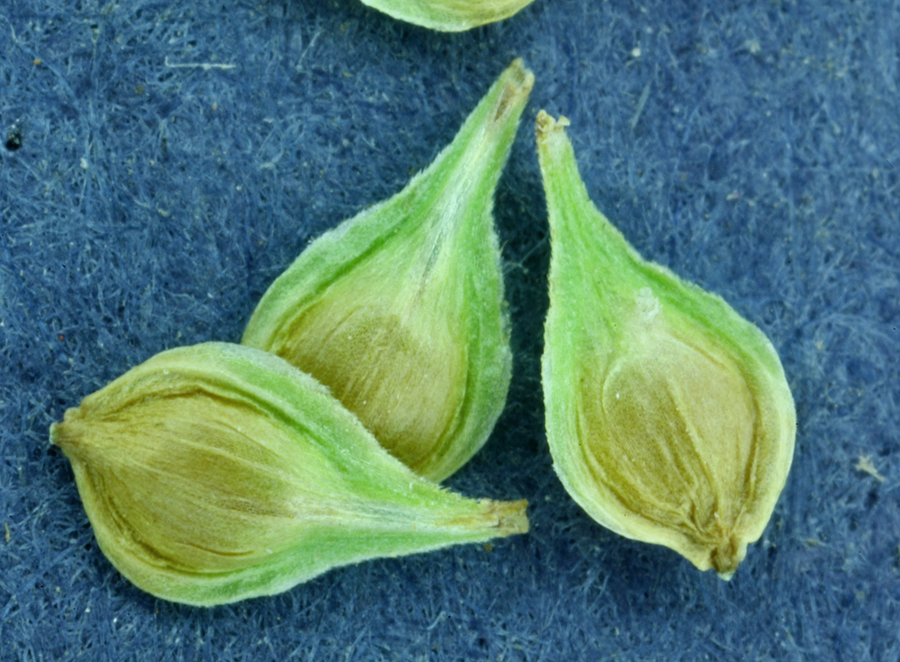 |
| Carex subfusca |
Carex subfusca |
Carex subfusca |
- 1' Perigynia larger, 3.2-7.9 mm long.
- 4. Perigynium evidently slender-beaked, the beak rather narrowly margined and serrulate in the proximal portion only, the distal 0.5 mm or more generally subterete, marginless, and entire or nearly so; inflorescence pale to often dark or bicolored.
- 5. Lowest bract of the inflorescence elongate, (1)-2-8-(10) cm long, equalling or usually much surpassing the inflorescence. Carex athrostachya
 |
 |
 |
| Carex athrostachya |
Carex athrostachya |
Carex athrostachya |
- 5' Bracts all short and inconspicuous, or the lowest one seldom setaceous-prolonged and up to about as long as the inflorescence.
- 6. Pistillate scales distinctly shorter and narrower than the perigynia, largerly exposing at least the distal margins as well as the beak or the perigynium.
- 7. Perigynium more or less distinctly plano-convex, the perigynial cavity nearly filled by the plump achene; W and S species (occasional specimens of the inland species C. petasata might be sought here, but have mostly larger perigynia and less crowded inflorescence than these species).
- 8. Perigynia 3.2-5.1 mm long, few- to several-nerved (nerves fewer than 10) dorsally, the ventral side similarly nerved or fewer-nerved or nerveless.
- 9. Perigynia up to 3.6 mm long, usually evidently nerved ventrally as well as dorsally; perigynia and scales commonly paler than in the next species; occasional specimens; Sevier, Wayne, Washington counties. Carex subfusca
|
|
|
| Carex subfusca |
Carex subfusca |
Carex subfusca |
- 9' Perigynia mostly 3.6-5.1 mm long, the ventral side usually nerveless or obscurely few-nerved; Weber, Salt Lake, Summit, Daggett, Wasatch, Duchesne, Uintah counties. Carex pachystachya
 |
 |
 |
| Carex pachystachya |
Carex pachystachya |
Carex pachystachya |
- 8' Perigynia mostly 4.5-6.2 mm long, obscurely to conspicuously multi-nerved (nerves 10 or more) dorsally and usually also ventrally, or the ventral nerves sometimes fewer or obsolete; Cache, Summit, Daggett, Uintah counties. Carex multicostata
 |
 |
| Carex multicostata |
Carex multicostata |
- 7' Perigynium more or less strongly flattened except where distended by the relatively small achene; inland species.
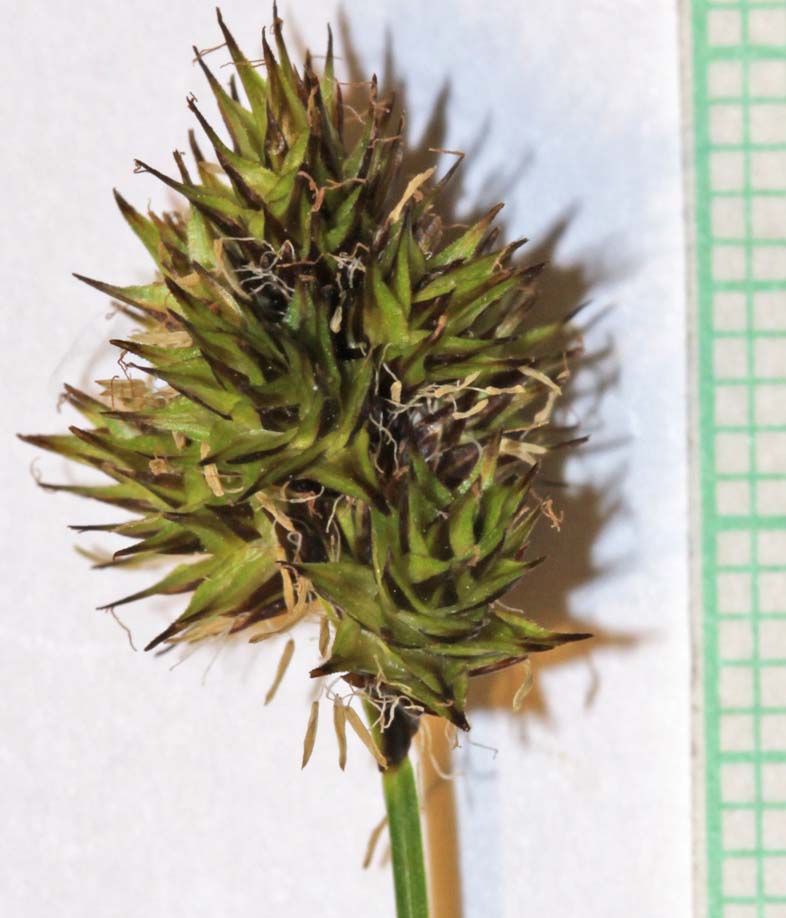
- 10. Perigynia middle-sized, mostly 3.2-5.0 mm long and 2-3-(4) times as long as wide, generally paler than the pistillate scales, and the spike thus conspicuously bicolored; plants mostly (1.5)-2-6 dm tall, occurring from the foothills to near timberline in the mountains. Carex microptera
 |
 |
 |
| Carex microptera |
Carex microptera |
Carex microptera |
Carex microptera |
- 10' Perigynia larger, mostly (4.5)-5.0-7.2 mm long, often nearly or quite as dark as the scales; plants mostly 1-3-(4) dm tall, occurring near or above the timberline in the mountains.
- 11. Perigynium mostly 1.8-3.3 times as long as wide, tending to have a pair of prominent inframarginal nerves delimiting the wing-margins; stipelike base of the achene (below the joint) inconspicuous, seldom over 0.5 mm long, or obsolete; widespread, but more common northward. Carex haydeniana
 |
 |
 |
 |
| Carex haydeniana |
Carex haydeniana |
Carex haydeniana |
Carex haydeniana |
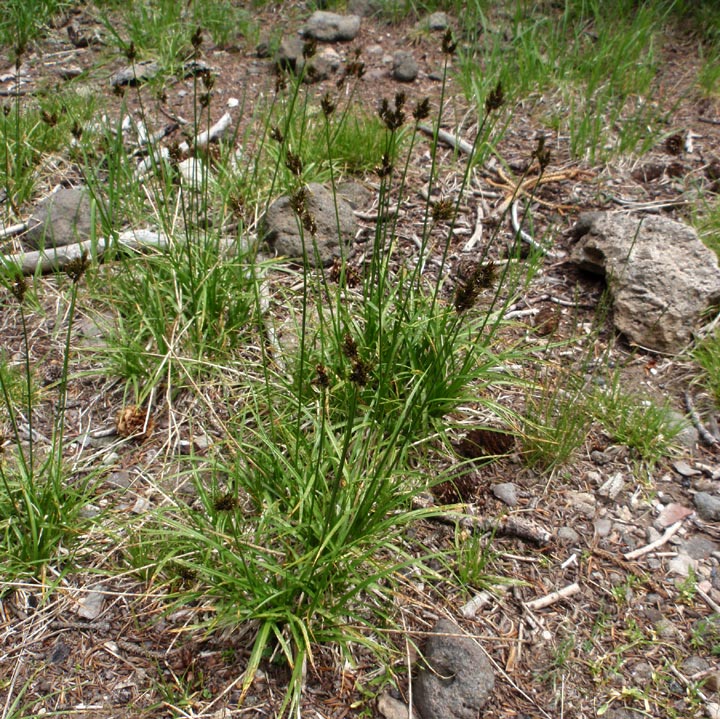
- 11' Perigynium mostly 3.4-5.0 times as long as wide, without prominent inframarginal nerves delimiting a wing-margin; achene jointed to a prominent, stipelike base commonly about (0.5)-1 mm long; S Rocky Mountains, to Utah and Arizona. Carex ebenea
 |
 |
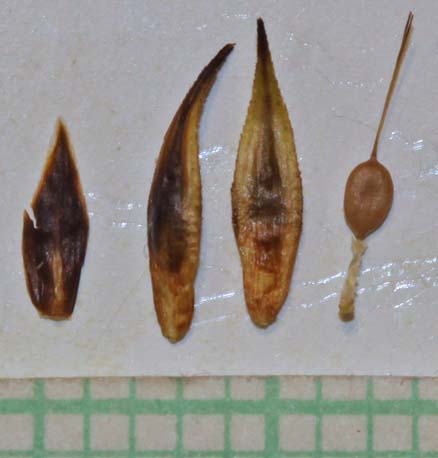 |
| Carex ebenea |
Carex ebenea |
Carex ebenea |
- 6' Pistillate scales nearly or quite as long and wide as the perigynia and more or less completely concealing them in dorsal view, the tip of the beak sometimes exposed.
- 12. Perigynia large, mostly 5.8-7.9 mm long, planoconvex, nerved on both sides, 2.6-4.0 times as long as wide; moderate and lower elevations, chefly in drylands. Carex petasata
 |
 |
| Carex petasata |
Carex petasata |
- 12' Perigynia smaller, 3.3-5.5-(6.0) mm long, variously shaped and nerved.
- 13. Perigynium small, only 3.2-4.0 mm long, 0.8-1.2 mm wide, and 3.3-4.0 times as long as wide, sharp-edged but scarsely wing-margined, the beak rather ill-defined; inflorescence compact, the first internode mostly 2-6-(9) mm long, the second one 1-5-(6) mm long; Summit, Wasatch, Duchesne counties. Carex leporinella
 |
 |
 |
 |
| Carex leporinella |
Carex leporinella |
Carex leporinella |
Carex leporinella |
- 13' Perigynium larger, mostly (3.6)-4.0-5.5-(6.0) mm long, 1.3-2.0 mm wide, and 2.2-4.0 times as long as wide, more or less distinctly wing-margined at least toward the distal part of the body, the beak often but not always well defined.
- 14. Plants of lowlands to moderate elevations in the mountains, often more than 4 dm tall; inflorescence relatively loose and flexuous, the two lowest internodes each 5-10-(15) mm long; leaves (1)-2-4 mm wide. Carex praticola
 |
 |
| Carex praticola |
Carex praticola |
- 14' Plants of high elevations in the mountains, near or above timberline, only 1-3-(4) dm tall; inflorescence more compact, the second internode mostly 2-5-(6) mm long, the first of similar length or sometimes longer and up to 10 mm; leaves 0.5-2-(2.5) mm wide.
- 14'1. Perigynia appressed or appressed-ascending, (0.6–)1–2 mm from beak tip to achene; pistillate scales with white margin 0.2–0.6 mm wide; achenes 0.5–0.7 mm thick. Carex tahoensis = Carex phaeocephala f. eastwoodiana
- 14'1' Perigynia ascending, 1.5–2.6 mm from beak tip to achene; pistillate scales with white-hyaline margin 0–0.3 mm wide; achenes 0.3–0.6 mm thick. Carex phaeocephala
 |
 |
 |
| Carex phaeocephala |
Carex phaeocephala |
Carex phaeocephala |
- 4' Perigynium with a flattened, broadly margined and serrulate, often ill-defined beak, this sometimes margined and serrulate throughout, or sometimes with a minute, subterete, marginless and entire tip less than 0.5 mm long; inflorescence (except in C. arapahoensis) relatively pale, greenish or stramineous to light brown in aspect.
- 15. Pistillate scales distinctly shorter and narrower than the perigynia, largely exposing at least the distal margins as well as the beak of the perigynium.
- 16. Dorsal surface of the perigynium evidently few-nerved, the nerves fewer than 10.
- 17. Perigynium 1-1.5 mm wide, 2.0-2.7-(3.0) times as long as wide, planoconvex, tapering to a rather ill-defined beak; achenes 0.6-0.8 mm wide; Uintah county. Carex bebbii
 |
 |
| Carex bebbii |
Carex bebbii |
- 17' Perigynium 2.2-3.4 mm wide, (1.2)-1.3-1.7-(1.8) times as long as wide, strongly flattened, the body suborbicular and more or less strongly contracted to the well defined beak; achenes 1.3-1.9 mm wide. Carex brevior
 |
 |
 |
| Carex brevior |
Carex brevior |
Carex brevior |
- 16' Dorsal surface of the perigynium obscurely to conspicuously multinerved, the nerves 10 or more.
- 18. Perigynia more or less strongly planoconvex; chiefly Cascade-Sierran species, occurring also in the mountains of E Oregon and C Idaho. Carex multicostata
|
|
| Carex multicostata |
Carex multicostata |
- 18' Perigynia more or less strongly flattened.
- 19. Spikes borne in a compact head, the first two internodes collectively only 4-7-(9) mm long; high elevations in the mountains.
- 20. Perigynia middle-sized, mostly 4.1-5.0 mm long and 1.5-2.3 mm wide; Cascade-Serra species, occurring also in the Wasatch Mountains of Utah; Box Elder, Tooele, Salt Lake, Utah, Wasatch, Duchesne counties. Carex straminiformis
 |
 |
| Carex straminiformis |
Carex straminiformis |
- 20' Perigynia large, mostly 5.5-7.5 mm long and 2.1-3.5 mm wide; species of the S Rocky Mountains and Colorado Plateau region. Carex egglestonii
 |
 |
 |
| Carex egglestonii |
Carex egglestonii |
Carex egglestonii |
- 19' Spikes borne in a more elongate, spiciform inflorescence, the first two internodes collectively (8)-10-18 mm long; mostly at middle elevations in the mountains, seldom above timberlilne; not reported from Utah. Carex xerantica
 |
| Carex xerantica |
- 15' Pistillate scales nearly or quite as long and wide as the perigynia and more or less completely concealing them in dorsal view, the tip of the beak sometimes exposed.
- 21. Perigynia larger, (4.2)-4.5-7.0 mm long and 1.9-2.8 mm wide, evidently wing-margined; species in our range confined to the Colorado Plateau region.
- 22. Spikes borne in a more or less elongate, spiciform inflorescence, the first two internodes collectively (8)-10-18 mm long; plants mostly 3-7 dm tall, commonly occurring at middle elevations in the mountains, seldom above timberline; not reported from Utah. Carex xerantica
|
| Carex xerantica |
- 22' Spikes aggregated into a compact head, the first two internodes collectively only 1.5-6 mm long; plants mostly 1.5-3-(4) dm tall, generally growing above timberline; Garfield, Grand, San Juan counties. Carex arapahoensis
 |
| Carex arapahoensis |
- 21' Perigynia smaller, 3.2-4.0 mm long and 0.8-1.2 mm wide, sharp-edged but scarsely wing-margined; chiefly Cascade-Sierran species, irregularly E to the Wasatch Mountains of Utah; Summit, Wasatch, Duchesne counties. Carex leporinella
|
|
|
|
| Carex leporinella |
Carex leporinella |
Carex leporinella |
Carex leporinella |