Cyperaceae
Intermountain Flora, v. 6, p. 67
Utah Flora 5th edition, p. 751
- 1. Achene not enclosed or enwrapped in a perigynium.
- 2. Scales of the spikelet spirally arranged.
- 3. Style not thickened, although the achene may have a stylar apicus; spikelets several or many in most species, solitary in a few.
- 4. Achene subtended by 1-many bristles (or these rarely obsolete) in addition to the scale of the spikelet; stamens (2)-3; most species perennial; achenes lenticular or often trigonous.
- 5. Perianth bristles 0-6, in most species not exceeding the scales (2 species of Eleocharis, with the basal stylar thickening not sharply set off from the body of the achene, might also be sought here). Scirpus
- 5' Perianth bristles numerous (more than 10), conspicuous and much elongate. Eriophorum
- 5'1. Spikelets 2 or more; anthers mostly 2.5-4 mm long; Duchesne, Daggett, Uintah counties. Eriophorum polystachion = Eriophorum angustifolium
 |
| Eriophorum polystachion |
- 5'1' Spikelets solitary; anthers mostly 0.5-1 mm long; Summit, Duchesne, Uintah counties. Eriophorum scheuchzeri
 |
| Eriophorum scheuchzeri |
- 4' Achene subtended by an inconspicuous, hyalilne, adaxial scale (or this rarely obsolete) in addition to the ordinary scale of the spikelet; small annuals with 1-(2) stamens and lenticular achenes. Cyperus aristulatus = Lipocarpha aristulata = Hemicarpha micrantha var. aristulata
 |
 |
| Hemicarpa micrantha |
Hemicarpa micrantha |
- 3' Style thickened toward the base, the thickened part often persistent on the achene as a tubercle.
- 6. Spikelet solitary; base of the style persistent on the achene as a tubercle; perianth bristles usually present. Eleocharis
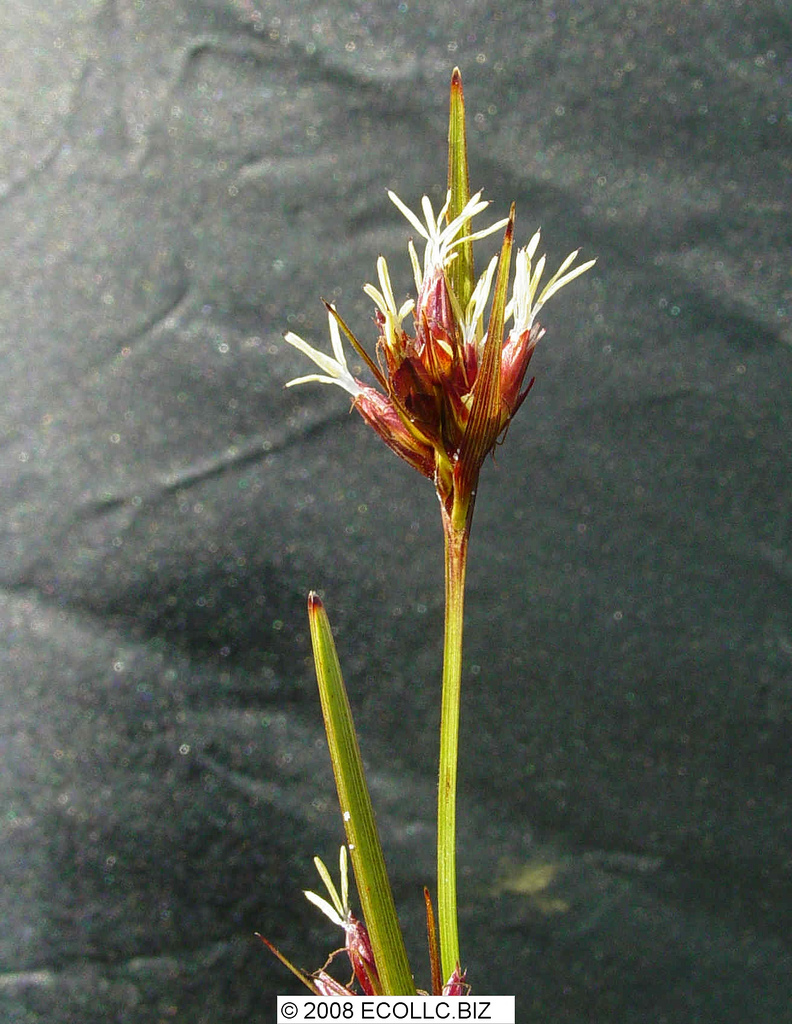
- 6' Spikelets several or many; style wholly decidious; perianth none; Utah, Millard, Washington, Kane, San Juan counties. Fimbristylis spadicea
 |
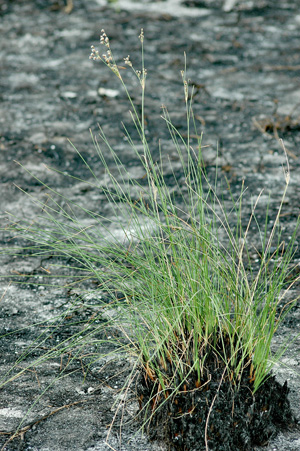 |
| Fimbristylis spadicea |
Fimbristylis spadicea |
- 2' Scales of the spikelet distichous, arranged in 2 vertical ranks. Cyperus
- 1' Achene enclosed or enwrapped in a perigynium, as well as subtended by a scale.
- 7. Perigynium open, with unsealed margins, merely wrapped around the achene; Summit, Daggett, Duchesne counties. Kobresia myosuroides = Kobresia bellardii
- 7.1. Perigynia 3.5–5.5 mm; scales 3.5–5 mm, midvein fading toward tip. Kobresia sibirica
- 7.1' Perigynia 2–3.5 mm; scales 2–3.5 mm, midvein distinct almost to tip.
- 7.2. Inflorescences usually compound, (2–)3–8 mm wide; basal sheaths persistent, dull, usually with remains of blades attached. Kobresia simpliciuscula
- 7.2' Inflorescences simple, 2–3 mm wide; basal sheaths persistent, somewhat glossy, bladeless. Kobresia myosuroides = Kobresia bellardii
 |
| Kobresia myosuroides |
- 7' Perigynium closed (except for the apical orifice), though often showing a dirsal suture distally. Carex
Scirpus
- 1. Involucre consisting only of 2 or 3 slightly modified empty scales less than cm long at the base of the solitary spikelet, which appears to be strictly terminal; lowest scale with a broad, blunt-tipped awn 1-3 mm long that sometimes shortly surpasses the spikelet; culms 1-4 dm tall, densely tufted, without long rhizomes; Summit, Wasatch, Daggett, Uintah counties. (sect. Baeothyron) Trichophorum cespitosum ssp. cespitosum = Scirpus cespitosus
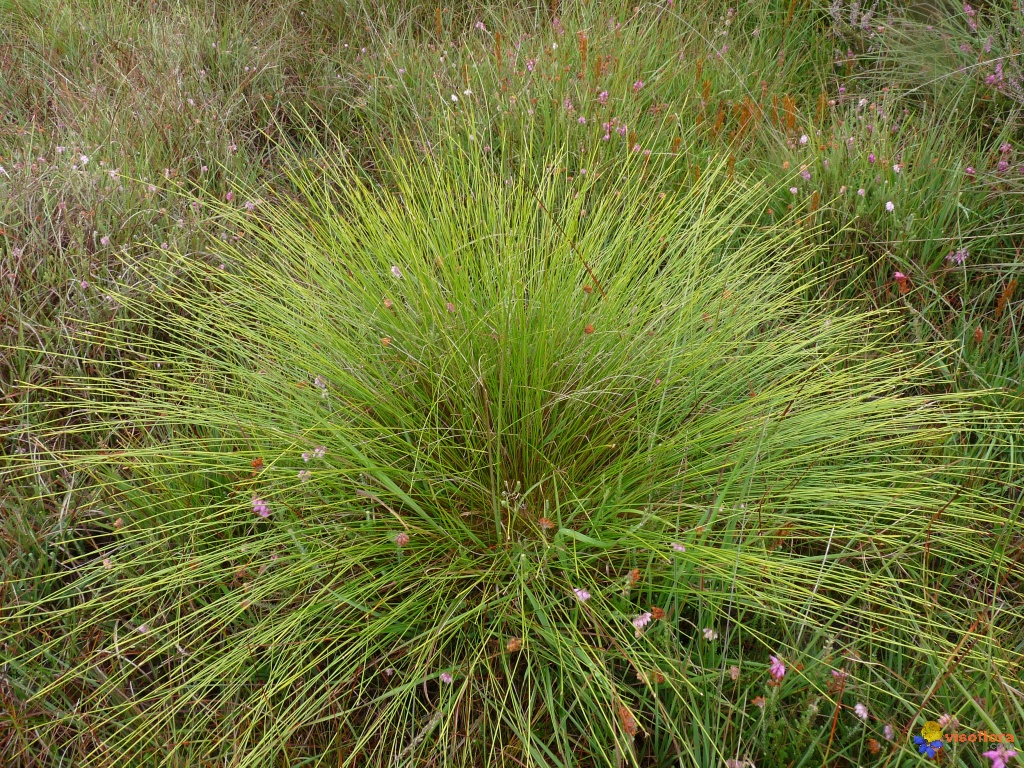 |
| Scirpus cespitosus |
- 1' Involucre very different from the scales, at least one of the bracts more or less elongate (at least 1 cm long) and either leaflike or resembling a prolongation of the culm.
- 2. Well developed involucral bracts 2 or more, commonly very unequal, but spreading, green, and leafy-textured, the inflorescence thus evidently terminal.
- 3. Spikelets small, mostly 3-6 mm long,very numerous (more than 100) in a branching inflorescence. Sect. Taphrogeton. Scirpus
- 4. Pistil tricarpellate; sheaths not antocyanic; midrib of the scales conspicuously excerted as a short. stiff awn; Utah, Uintah, Washington counties. Scirpus pallidus
 |
| Scirpus pallidus |
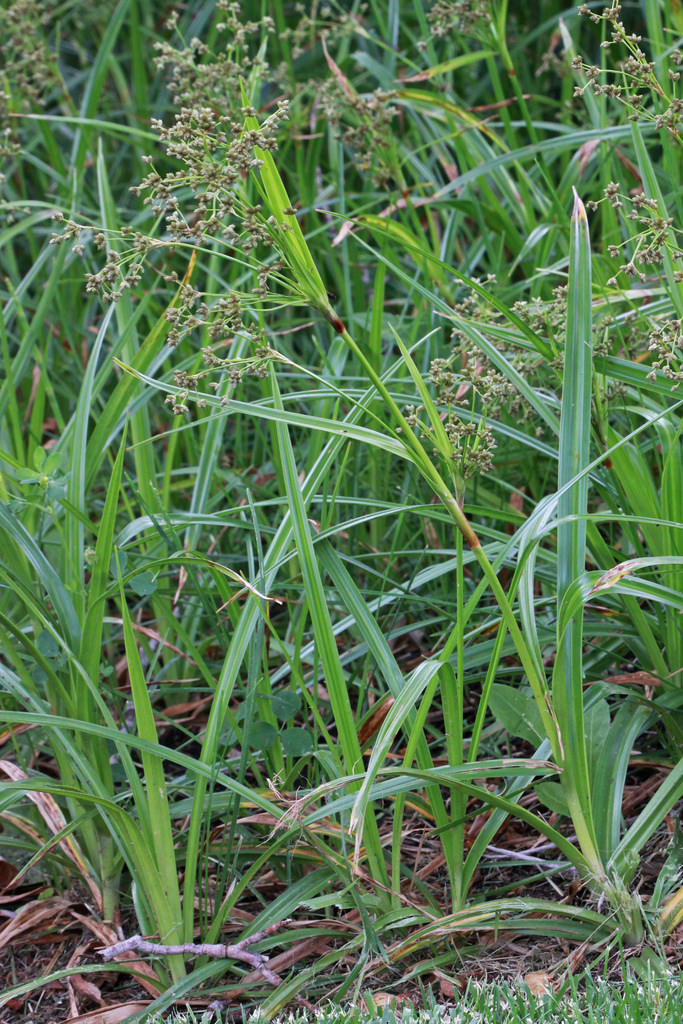
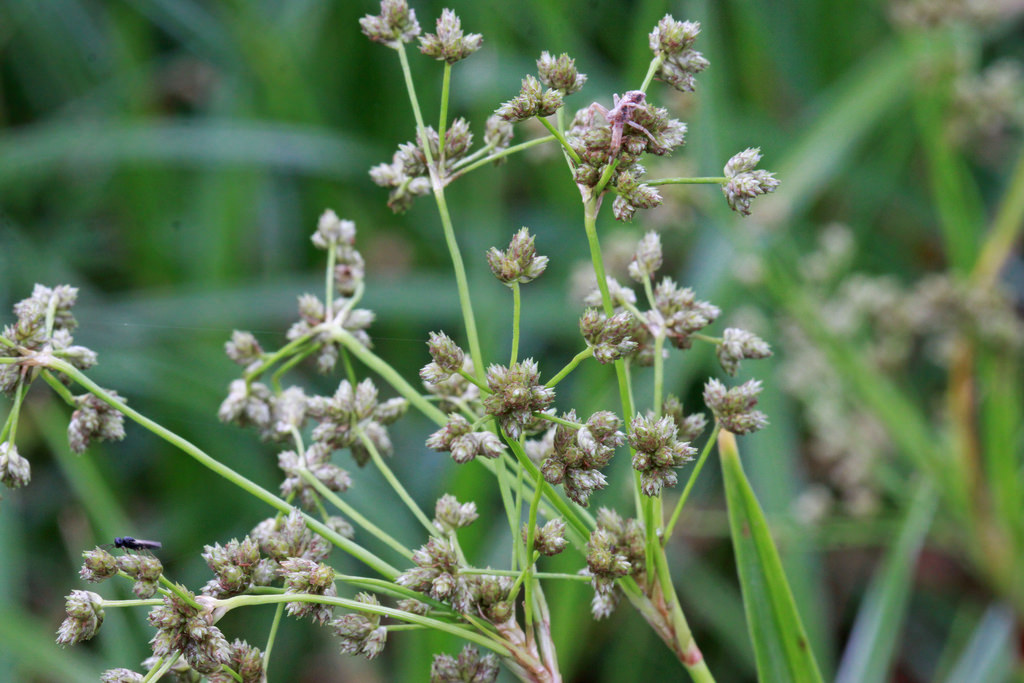
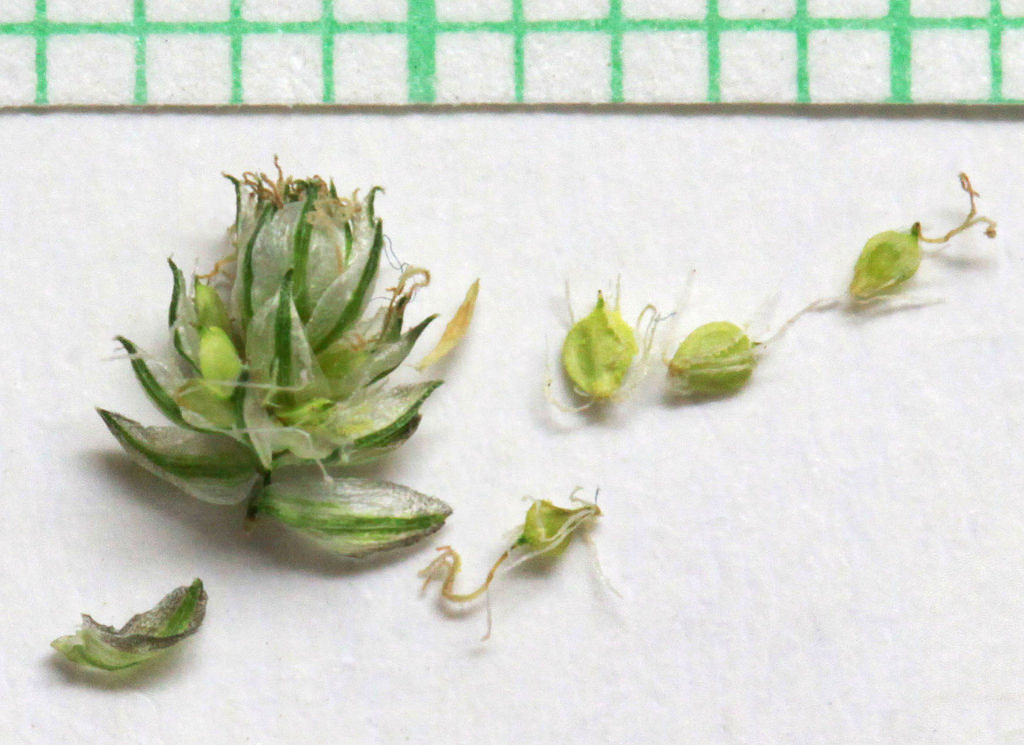
- 4' Pistil bicarpellate; sheaths mostly antocyanic; midrib of the scales not excerted, or only very shortly and inconspicuously so. Scirpus microcarpus
 |
 |
 |
| Scirpus microcarpus |
Scirpus microcarpus |
Scirpus microcarpus |
- 3' Spikelets larger, mostly 12-25 mm long, not very numerous (commonly 3-40), either all sessile in a compact terminal cluster, or the principal cluster surpassed by one or more rays each bearing a subsidary cluster or a single spikelet. Sect. Bulboschoenus. Bolboschoenus
- 5. Pistil tricarpellate; Box Elder, Cache, Dagget counties. Bolboschoenus fluviatilis = Scirpus fluviatilis
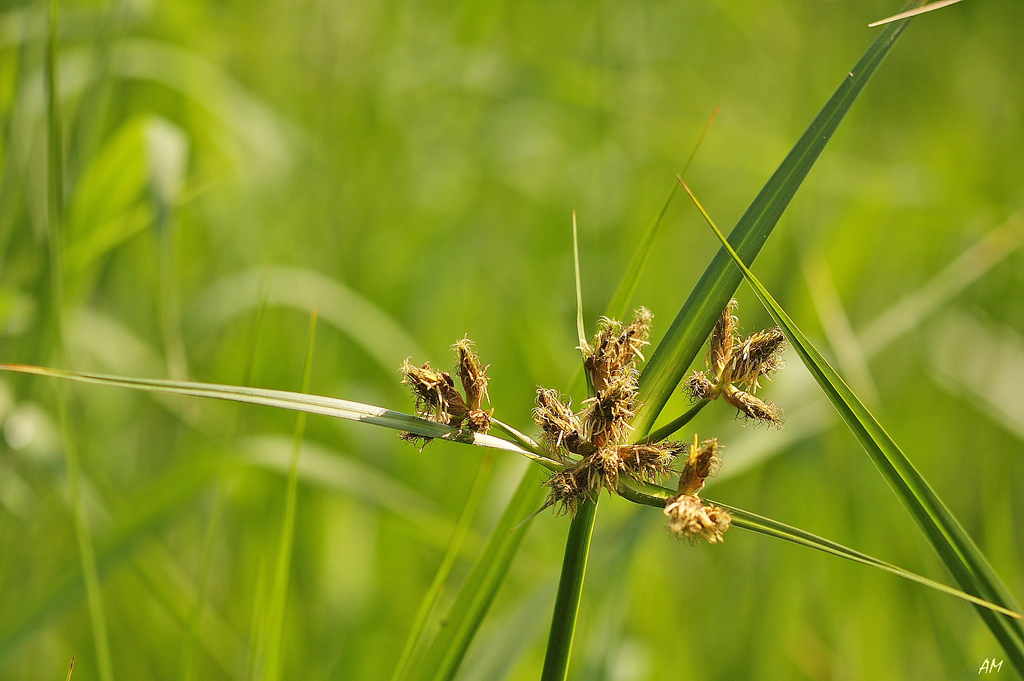 |
| Scirpus fluviatilis |
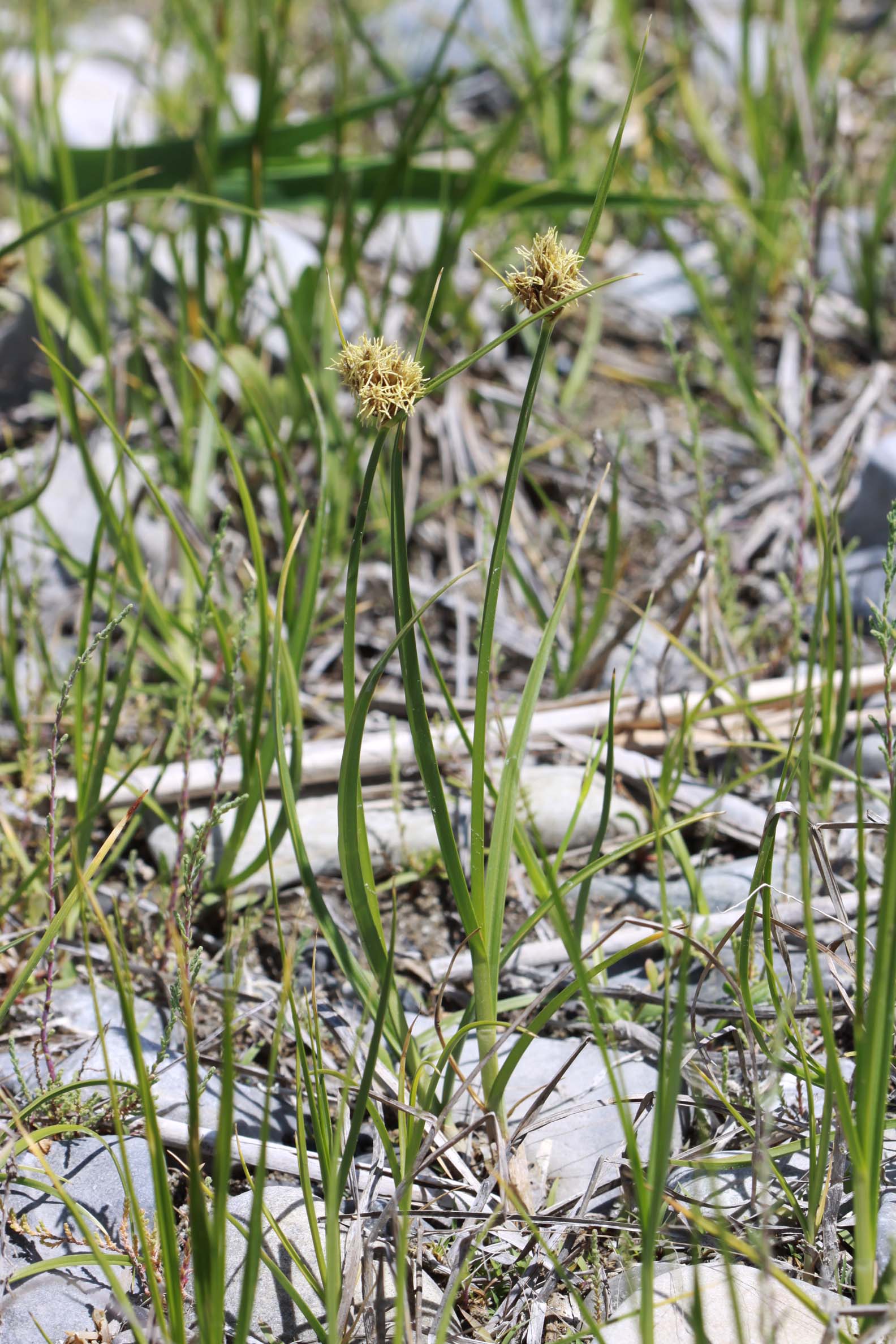
- 5' Pistil bicarpellate. Bolboschoenus maritimus = Scirpus maritimus
 |
 |
| Scirpus maritimus |
Scirpus maritimus |
- 2' Well developed involucral bracts solitary, green, leafy or more often erect and resembling a prolongation of the culm, so that the inflorescence appears to be lateral near the tip of the stem rather than truly terminal; smaller involucral bracts sometimes present, but scale-like and not chlorophyllous.
- 6. Rhizomatous perennials, often well over 3 dm tall; achenes smooth or cellular-reticulate. Sect. Pterolepis, sensu lato.
- 7. Spikelets numerous (more than 15) in a branching inflorescence, often sessile in clusters at the ends of the branches; culms terete. Sect. Pterolepis, sensu stricto
- 8. Spikelets appearing dull gray-brown, the individual scales (at 10 x) with prominent red-brown striolae on a pale, gray-white background; scales, at least the middle and lowers ones, mostly (3)-3.5-4 mm long. Schoenoplectus acutus = Scirpus acutus
 |
 |
 |
| Scirpus acutus |
Scirpus acutus |
Scirpus acutus |
- 8' Spikelets appearing more reddish-brown, the individual scales with a brownish or tawny ground-color, so that the red-brown striolae are usually not prominent; scales mostly (2)-2.5-3-(3.5) mm long. Schoenoplectus tabernaemontani = Scirpus validus
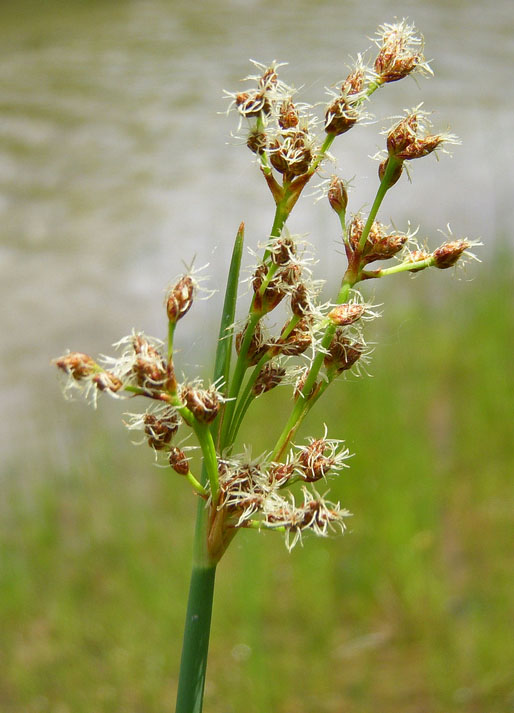 |
| Scirpus validus |
- 7' Spikelets solitary or few (up to 10 or seldom 15), sessile in a sessile cluster. Sect. Schoenoplectus
- 9. Spikelets usually 2 or more, occasionally solitary on some culms; plants sometimes growing in shallow water, but the culms stiff and emergent for most of their length.
- 10. Achenes evidently apiculate, not cellular-reticulate even at 20x; culms more or less distinctly triquetrous.
- 11. Bract solitary; culms very sharply triquetrous, with notably concave sides; achenes 1.8-2.5 mm long and 1.4-1.7 mm wide. Schoenoplectus americanus = Scirpus americanus
 |
| Scirpus americanus |
- 11' Bracts 2 or 3, the second and third ones resembling enlarged scales of the spikelet, but not subtending flowers; culms not very sharply triquetrous, the side plane to slightly concave or slightly convex; achenes 2.2-3.3 mm long and 1.6-2.3 mm wide. Schoenoplectus pungens var. longispicatus = Scirpus pungens
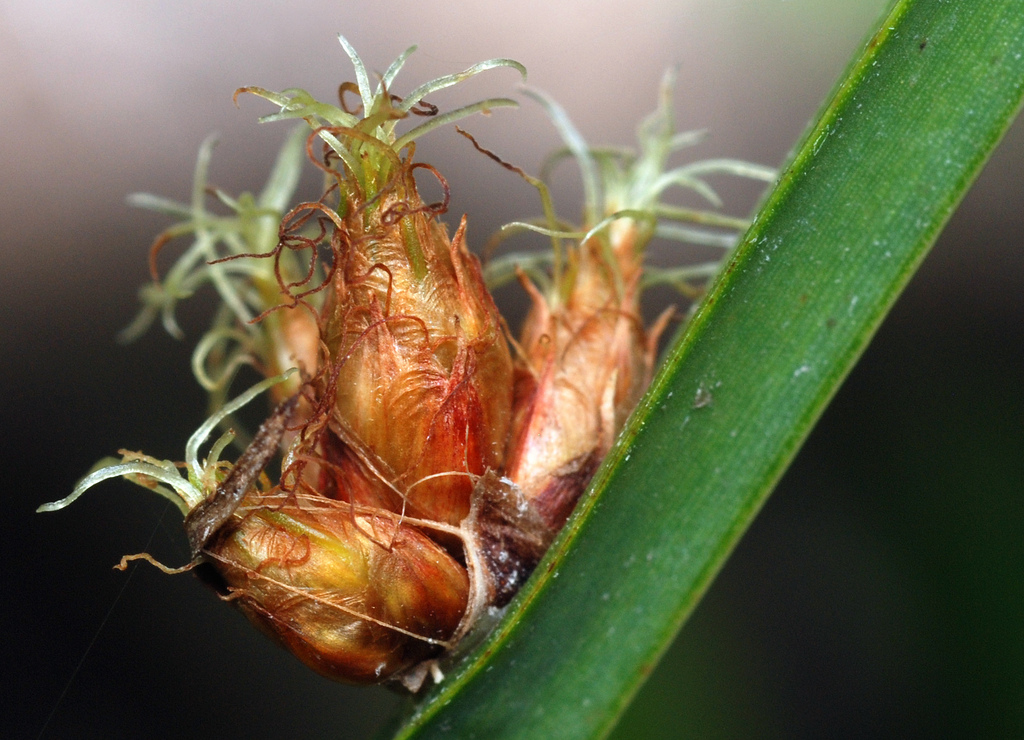 |
| Scirpus pungens |
- 10' Achenes not at all apiculate, evidently cellular-reticulate at 10x; culms subterete; Cache, Juab counties. Amphiscirpus nevadensis = Scirpus nevadensis
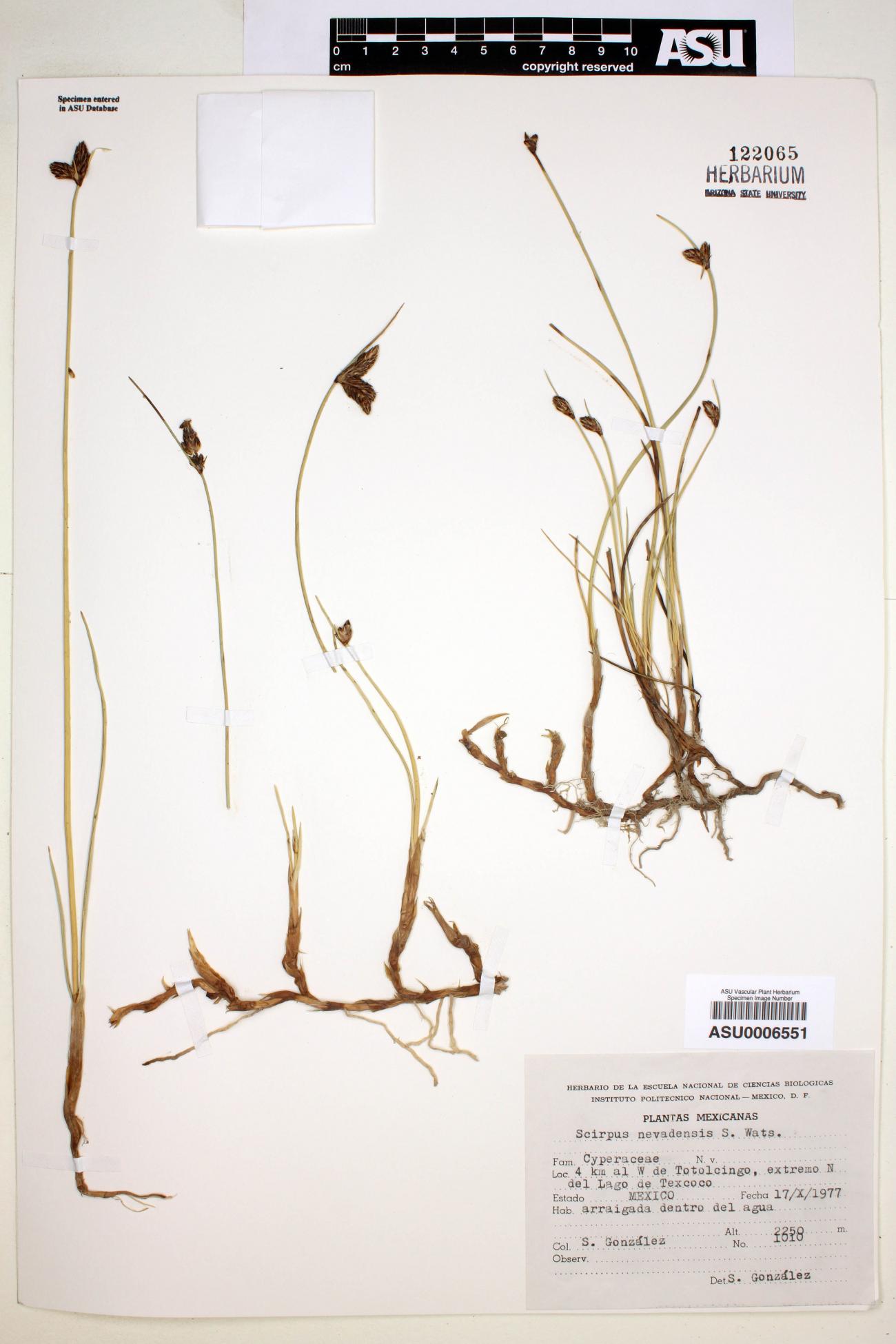 |
| Scirpus nevadensis |
- 9' Spikelet strictly solitary; plants usually aquatic and with flaccid, distally floating stems and leaves. Schoenoplectus subterminalis = Scirpus subterminalis
 |
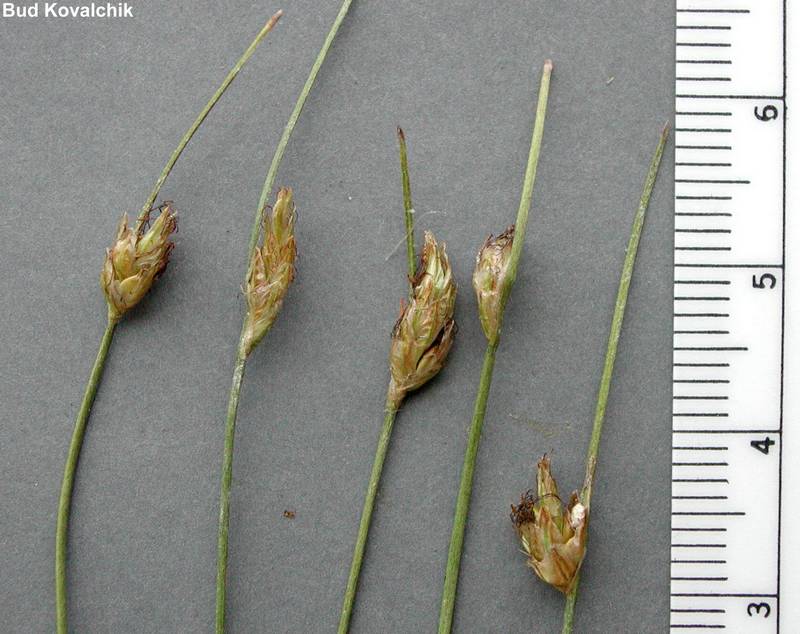 |
| Scirpus subterminalis |
Scirpus subterminalis |
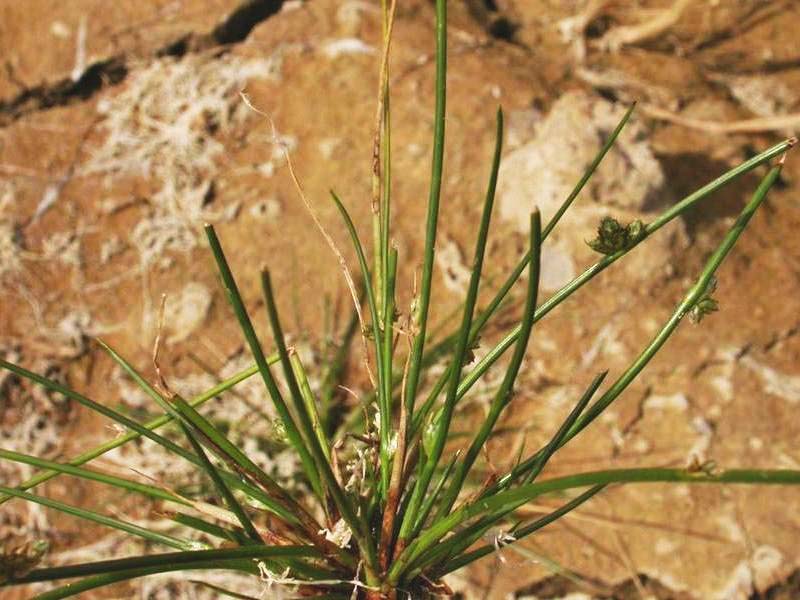
- 6' Fibrous-rooted annuals, seldom over 3 dm tall; achenes cross-ridged; near Great Salt Lake. Sect. Actaeogeton Schoenoplectiella saximontana = Schoenoplectus saximontanus = Scirpus supinus var. saximontanus
 |
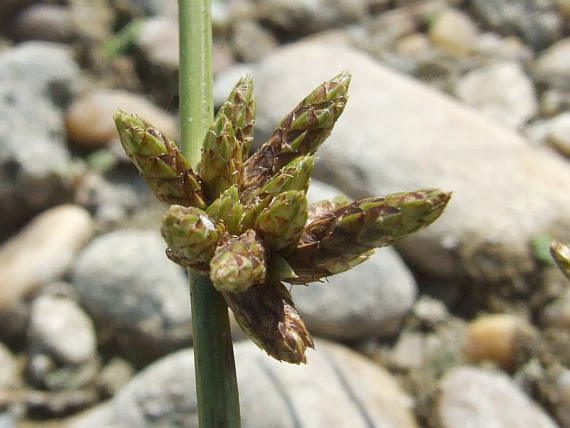 |
| Scirpus supinus |
Scirpus supinus |
Eleocharis
Intermountain Flora, vol. 6, p. 81
- 1. Stigmas 3; achenes more or less distinctly trigonous; flowers mostly 2-30 in each spikelet.
- 2. Tubercle confluent with achene, not forming a distinct apical cap.
- 3. Achenes and scales small, the achenes 0.9-1.3 mm long (including the tubercle), the scales mostly 1.5-2-(2.5) mm long; very small plants, mostly 0.2-0.6-(1) dm tall; spikelets 2.5-4-(6) mm long, with 2-9-(20) flowers; lowest scale empty; Salt Lake, Utah, Uintah, Millard, Washington counties. Eleocharis coloradoensis = Eleocharis parvula var. anachaeta
 |
 |
| Eleocharis coloradoensis |
Eleocharis coloradoensis |
- 3' Achenes and scales larger, the achenes 1.9-2.8 mm long, the scales mostly 2.5-5.5 mm long; larger plants, seldom less than (0.5)-1 dm tall.
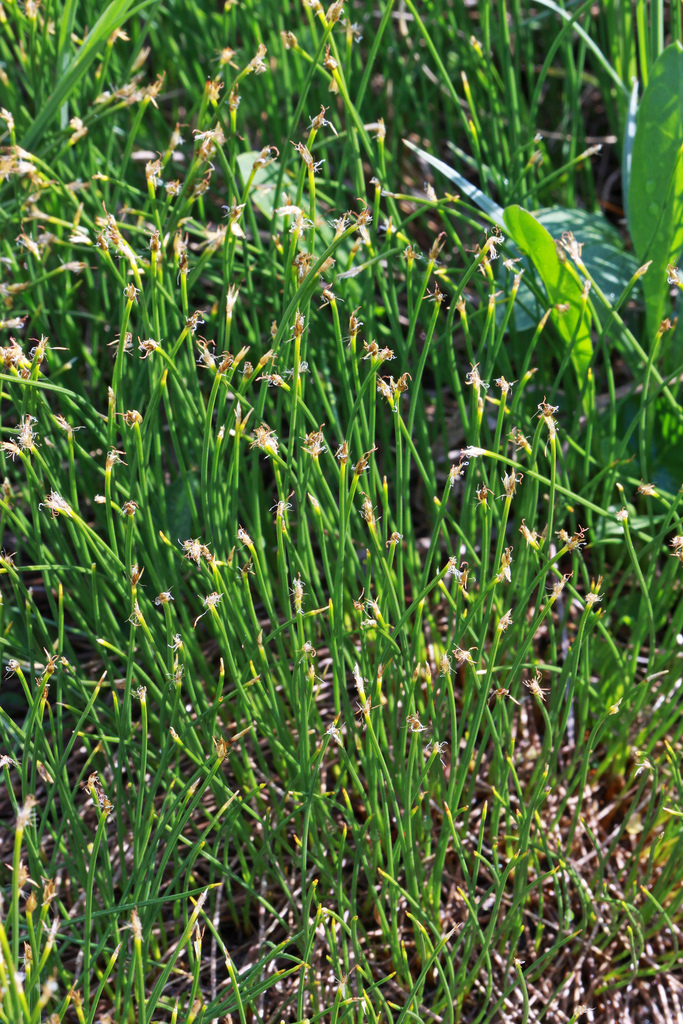
- 4. Lowest scale, like the others, ordinarily subtending a flower; stems slender and short, (0.5)-1-3-(4) dm tall, seldom as much as 1 mm wide, not flattened, not proliferous; spikelets 4-8 mm long, with mostly 3-9 flowers. (Subgenus Zinserlingia) Eleocharis quinqueflora = Eleocharis pauciflora
 |
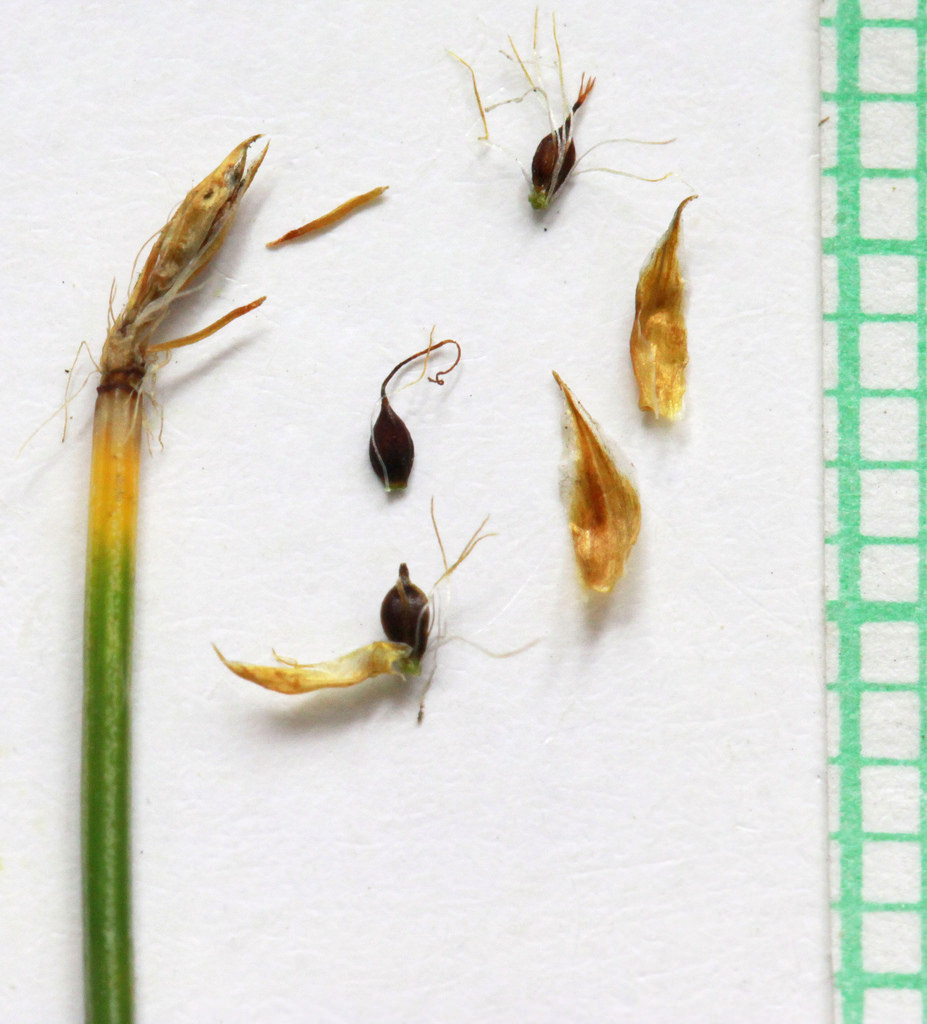 |
| Eleocharis quinqueflora |
Eleocharis quinqueflora |
- 4' Lowest scale empty; stems coarser, mostly (2)-4-10 dm tall or more, more or less flattened at least distally and commonly 1-2 mm wide, some of them usually proliferous; spikelets (5)-8-13 mm long, with (5)-10-20-(25) flowers. Eleocharis rostellata
 |
 |
| Eleocharis rostellata |
Eleocharis rostellata |
- 2' Tubercle forming a distinct apical cap well differentiated from the body of the achene.
- 5. Achene whitish or pale gray to ochroleucous, longitudinally many-ribbed, with numerous fine cross-ridges, forming ladderlike configurations; scales usually with green or stramineous midvein, not notably pale-tipped, the lowest one floriferous, not markedly broader or different from the others. (Subgenus Scirpidium)
- 6. Perennial, rhizomatous; anthers 0.7-1.3 mm long (dry); scales (1.3)-1.5-2.2 mm long. Eleocharis acicularis var. acicularis
 |
 |
| Eleocharis acicularis |
Eleocharis acicularis |
- 6' Annual, rarely rhizomatous; anthers 0.25-0.4 mm long; scales 1.0-1.3 mm long; Washington county. Eleocharis bella
 |
| Eleocharis bella |
- 5' Achene golden yellow (reputedly sometimes black), merely 3-ribbed, the surface finely cellular-roughened; scales (except the broader, often suborbicular, usually sterile lowest one) largely or wholly dark (often blackish purple) except for the conspicuously pale and hyaline tip.
- 7. Tubercle low and broad with a central apiculus, broader than high; rhizomes short and stout; spikelets mostly 2-3 times as long as wide, up to abous 8 mm long; north of latitude 40 in our range; Cache, Summit, Daggett, Duchesne, Millard, Washington, Grand, San Juan counties. Eleocharis bolanderi
 |
| Eleocharis bolanderi |
- 7' Tubercle narrow and high, about as high as wide; rhizomes slender (often lost when the plants is collected); spikelets mostly 3-7 times as long as wide, usually more than 8 mm long; chiefly south of latitude 40 in our range. Eleocharis parishii
 |
| Eleocharis parishii |
- 1' Stigmas 2 (sometimes 3 in E. engelmannii, an annual with numerous flowers in each spikelet); achenes lenticular.
- 8. Rhizomatous perennial; anthers mostly 1.3-2.5 mm long; achenes mostly over 1.5 mm long (tubercle included); scales mostly 2-4.5 mm long.
- 8.1. Distal sheaths delicately membranous, often inflated and wrinkled, usually disintegrating; culms 0.3–0.6 mm wide, 3–42 cm tall; spikelets ovoid. Eleocharis flavescens
- 8.1' Distal sheaths firmly membranous to papery, not inflated or wrinkled, sometimes splitting but evident and not disintegrating; culms 0.3–5 mm wide, 8–115 cm tall; spikelets lanceoloid to cylindric.
- 8.2. Proximal scale nearly orbicular, clasping 100% of the culm circumference; 2nd proximal scale with flower; culms 0.3–0.8(–1.4) mm wide, averaging 0.6 mm wide (Rothrock 2009), terete; spikelet 3–18 mm long; floral scales 15–50; anthers 1–1.2[–1.8] mm long. Eleocharis erythropoda
- 8.2' Proximal scale suborbicular to longer than wide, clasping ⅔–¾ (occasionally 100% in E. macrostachya) of the culm circumference; 2nd proximal scale with or without flower; culms 0.5–5 mm wide, averaging 1.3 mm wide, terete or compressed; spikelet 5–40 mm long; floral scales 30–100; anthers 1.3–2.7 mm long.
- 8.3. Stem often strongly compressed; distal sheath summit subtruncate, sometimes with apical tooth, rarely splitting; spikelets 5–40 mm long, the apex often sharply pointed; proximal scale clasping ¾–100% of culm; 2nd proximal scale with or without flower; 3rd proximal scale with flower. Eleocharis macrostachya
- 8.3' Stem terete to slightly compressed; distal sheath summit oblique, without apical tooth, often splitting; spikelets 5–25 mm long, the apex rounded to pointed; proximal scale clasping 2/3–3/4 of culm; 2nd proximal scale without flower; 3rd proximal scale with or without flower. Eleocharis palustris
 |
 |
 |
| Eleocharis palustris |
Eleocharis palustris |
Eleocharis palustris |
- 8' Annual; anthers mostly 0.25-0.8 mm long; achenes up to about 1.5 mm long; scales often less than 2 mm long.
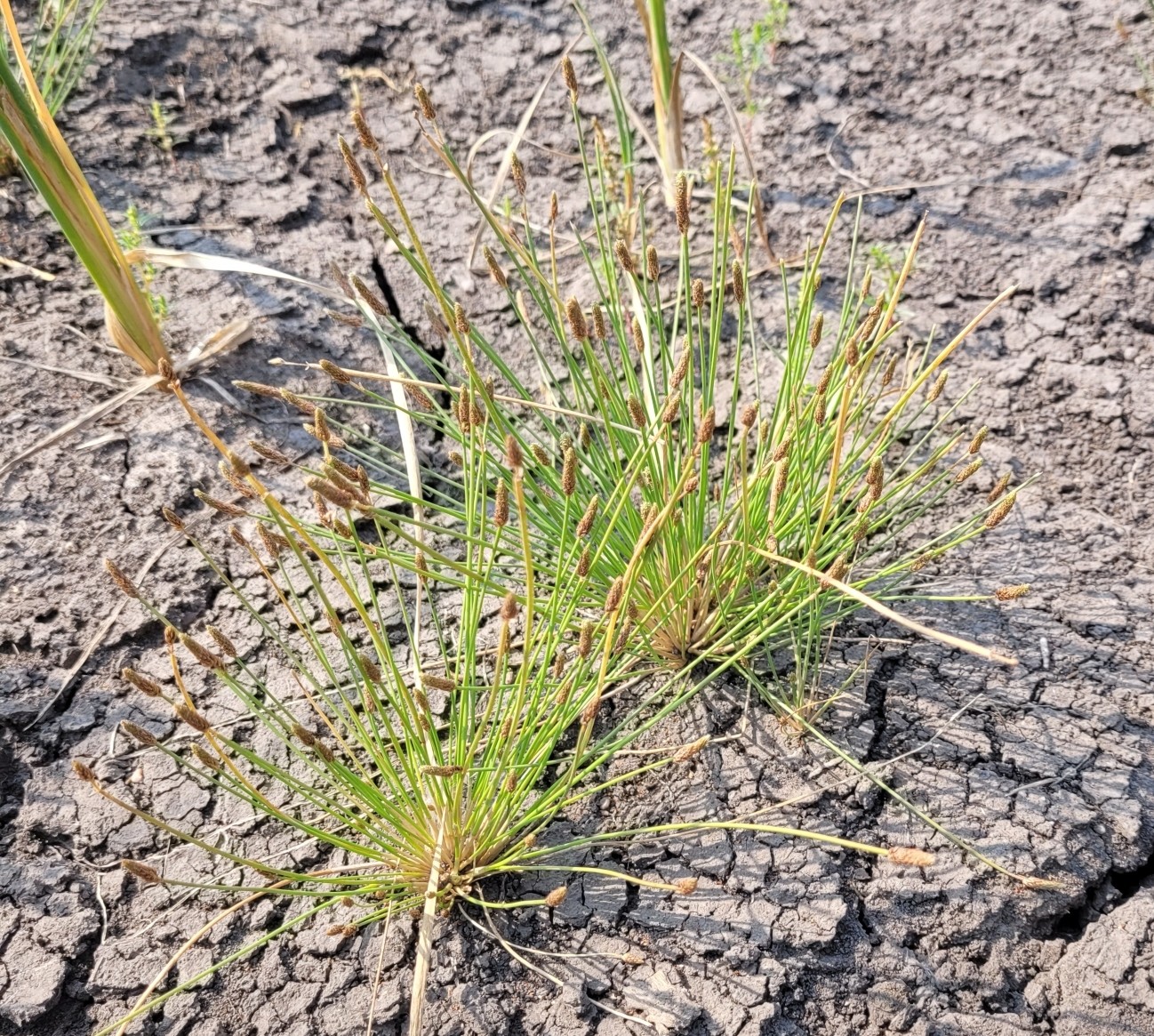
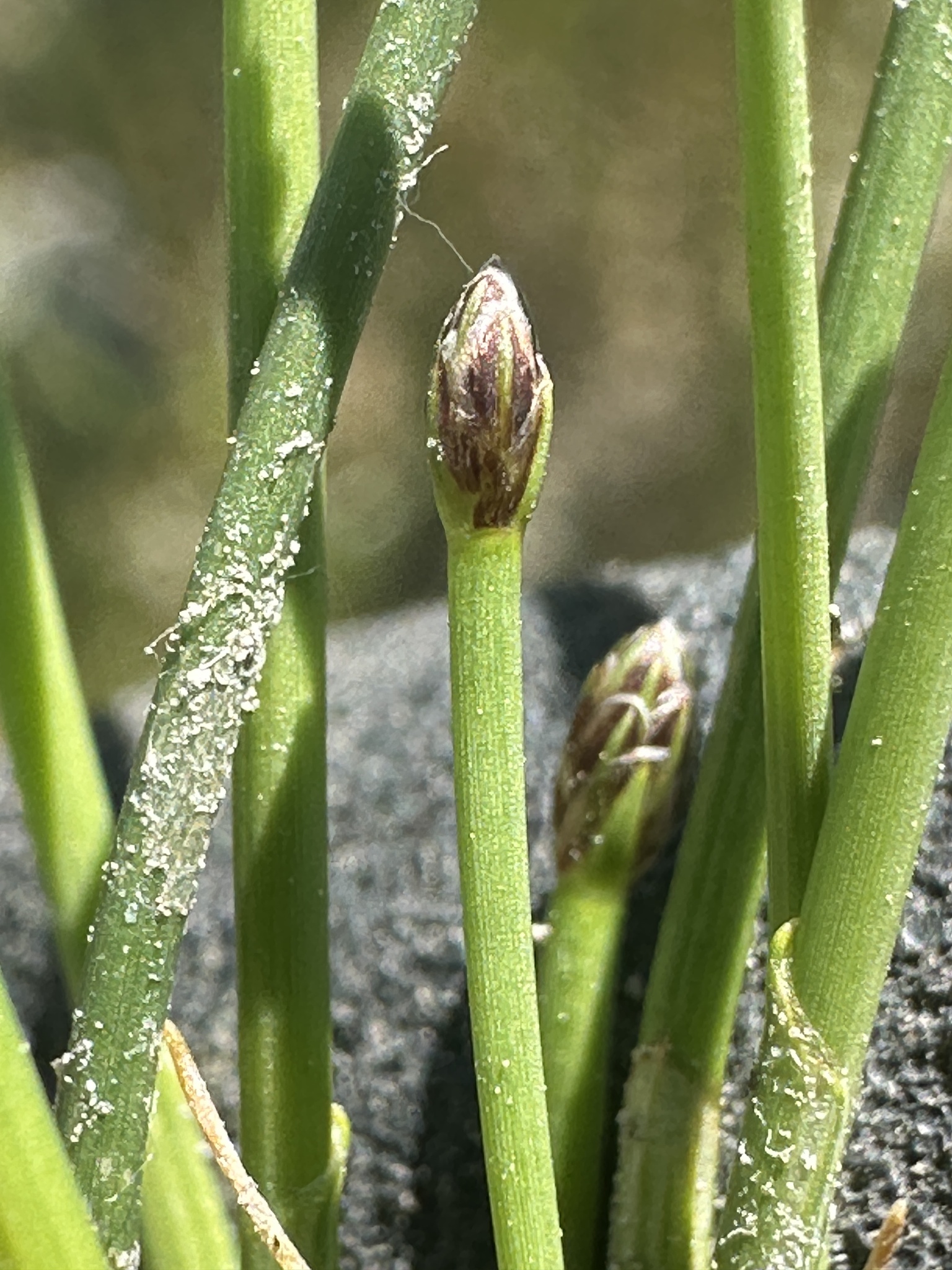
- 9. Achene stramineous to dark brown, mostly 1.0-1.5 mm long (tubercle included); Utah County (shore of Utah Lake), Kane county (Coral Pink Sand Dunes, near Sand Spring). Eleocharis engelmannii = Eleocharis ovata var. engelmannii
 |
 |
| Eleocharis engelmannii |
Eleocharis engelmannii |
- 9' Achene black, 0.7-1.0 mm long; widespread, chiefly tropical and subtropical species to be sought along the S border of our range. Eleocharis geniculata = Eleocharis caribaea
 |
| Eleocharis geniculata |
Cyperus
Intermountain Flora, vol. 6, p. 88
- 1. Plants perennial (except C. erythrorhizus); spikelets borne in more or less elongate and open, cylindric spikes (except in C. schweinitzii and sometimes C. esculentus); rachilla winged (or scarsely so in C.schweinitzii); stamens 3; pistil tricarpellate.
- 2. Perennial; scales relatively large, 2-6 mm long, not very closely set, the tip of each scale surpassing the one below it by 1-3 mm; achenes 1.3-2.5 mm long.
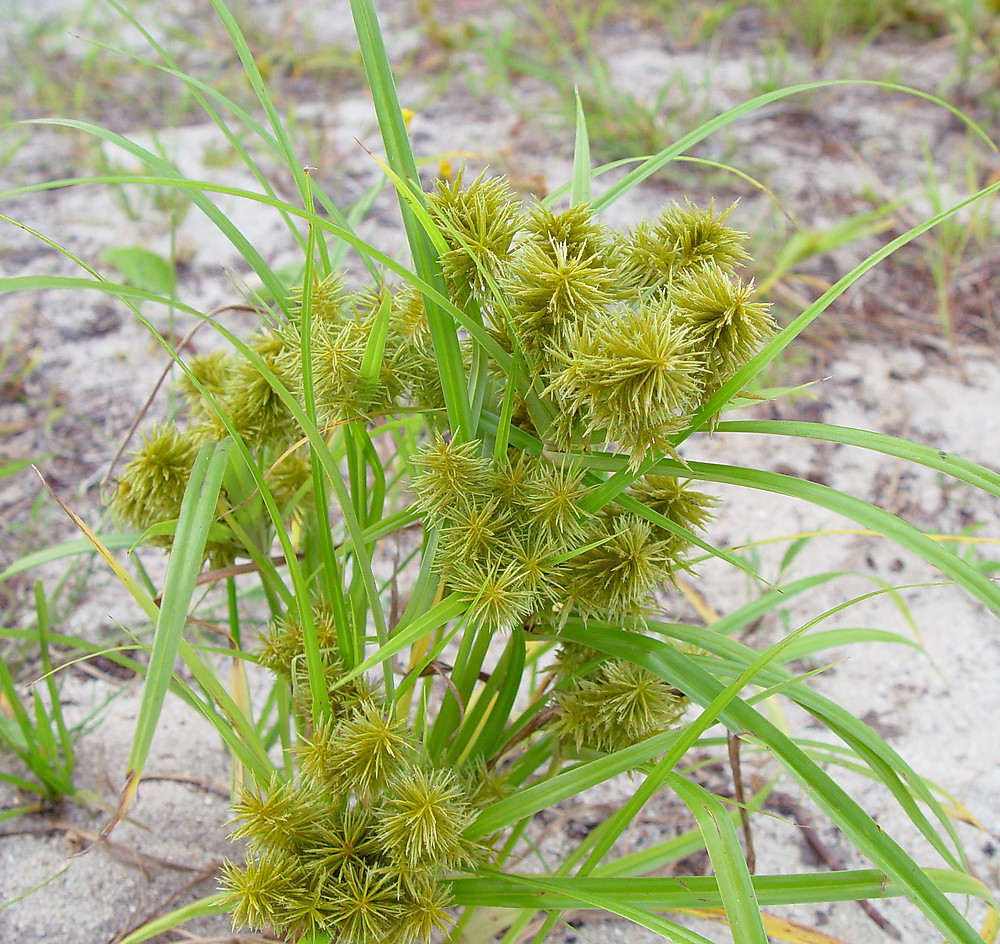
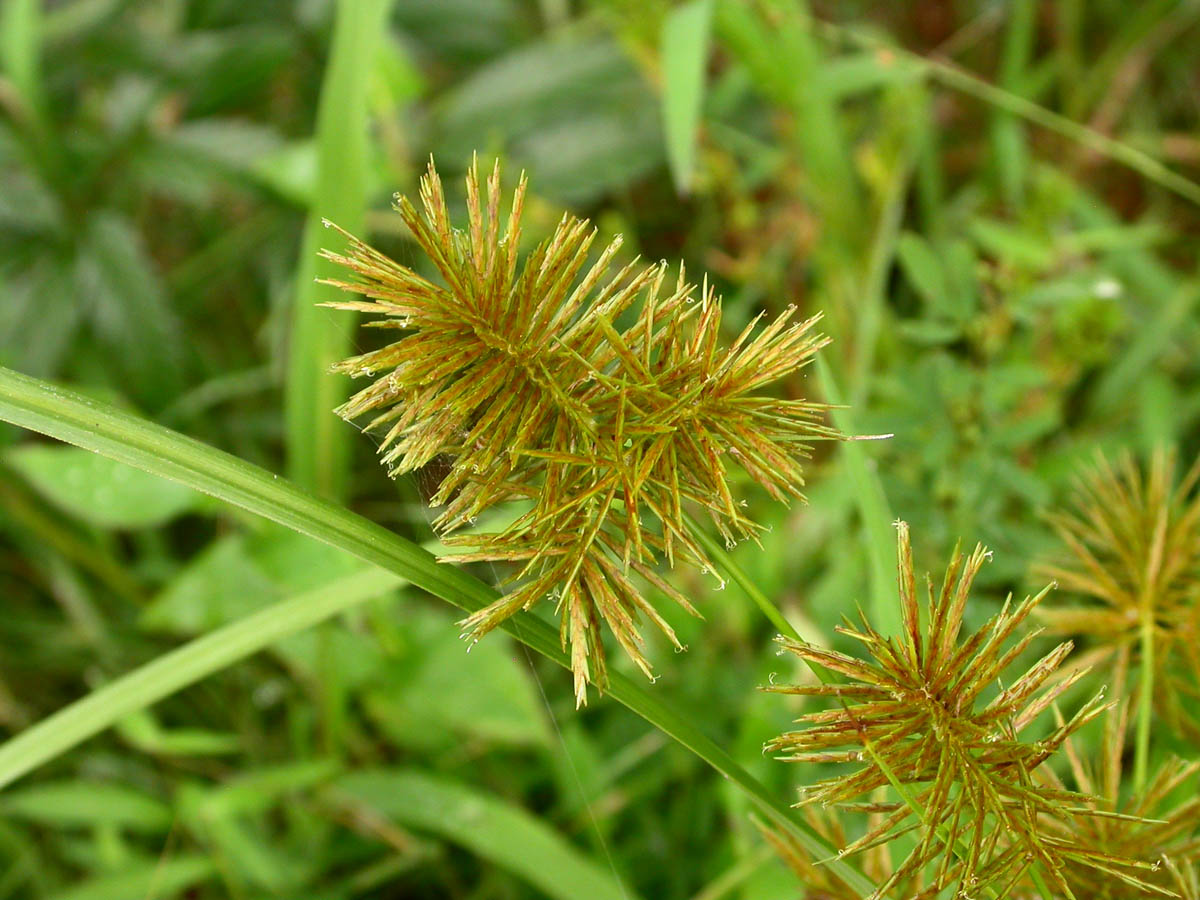
- 3. Wings of the rachilla clasping each achene toward the base; plants wholly without rhizomes; spikelets decidious at maturity, the rachilla disarticulating just above the base, the individual scales not falling away from the rachilla. Cyperus strigosus
 |
 |
| Cyperus strigosus |
Cyperus strigosus |
- 3' Wings of the rachilla narrow, not clasping the achene, or the rachilla scarsely winged; plants rhizomatous; scales falling from the rachilla at maturity, the rachilla sometimes (in C. schweinitzii) thereafter itself decidious.
- 4. Rhizomes short, thickened at intervals, bur scarsely tuber-bearing; clusters of spikelets relatively short and dense, subcapitate; rachilla narrowly or scarsely winged, the wing when present firm, not hyaline. Cyperus schweinitzii
 |
 |
| Cyperus schweinitzii |
Cyperus schweinitzii |
- 4' Rhizomes elongate, slender, with a terminal tuber; clusters of spikelets usually elongate, open, and more or less cylindric, seldom more condensed; rachilla evidently hyaline-winged. Cyperus esculentus
 |
 |
| Cyperus esculentus |
Cyperus esculentus |
- 2' Annual; scales small, mostly 1.2-1.5 mm long, closely set, the tip of each scale surpassing the one below it by 0.4-0.7 mm; achene 0.7-1.0 mm long. Cyperus erythrorhizos
 |
 |
 |
| Cyperus erythrorhizos |
Cyperus erythrorhizos |
Cyperus erythrorhizos |
- 1' Plants annual; spikelets borne in very short, more or less capitate clusters with a very short rachis; rachilla wingless; stamens 1 or 2, rarely 3.
- 5. Pistil tricarpellate; stamen 1; scales sharp-pointed or awn-tipped, often outcurved distally, often less than 2 mm long.
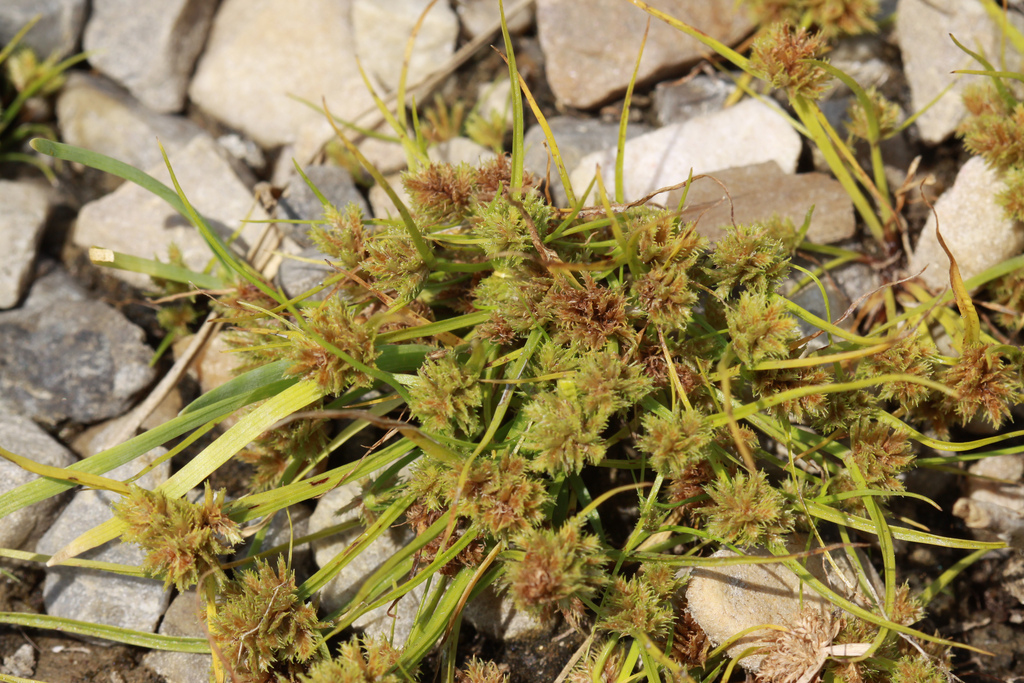
- 6. Scales (5)-7-9-nerved, with a slender, squarrose-recurved, short but distinct awn-tip. Cyperus squarrosus = Cyperus aristatus
 |
 |
 |
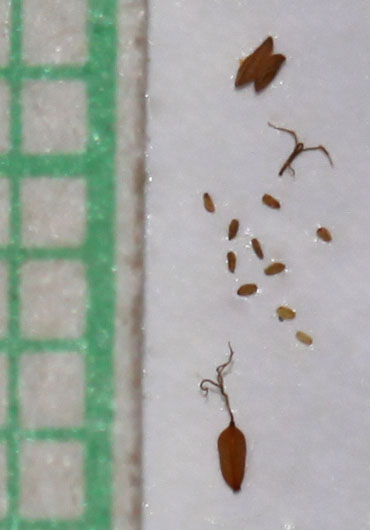 |
| Cyperus aristatus |
Cyperus aristatus |
Cyperus aristatus |
Cyperus aristatus |
- 6' Scales 3-nerved, tending to be recurved-acuminate, but not awn-tipped. Cyperus acuminatus
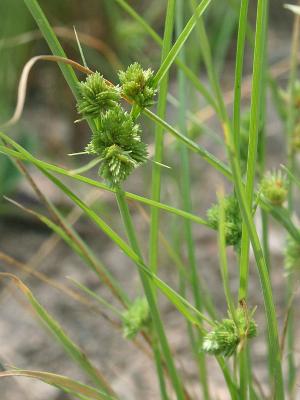 |
| Cyperus acuminatus |
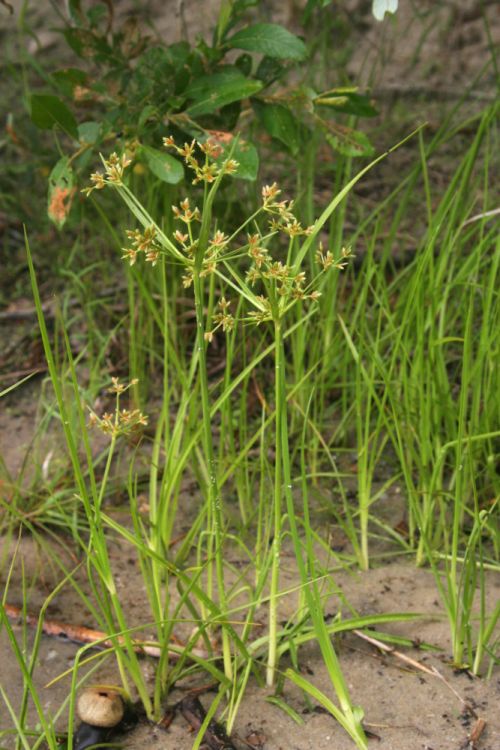
- 5' Pistil bicarpellate; stamens 2-(3); scales mostly 2-2.5 mm long, straight, blunt. Cyperus rivularis = Cyperus bipartitus
 |
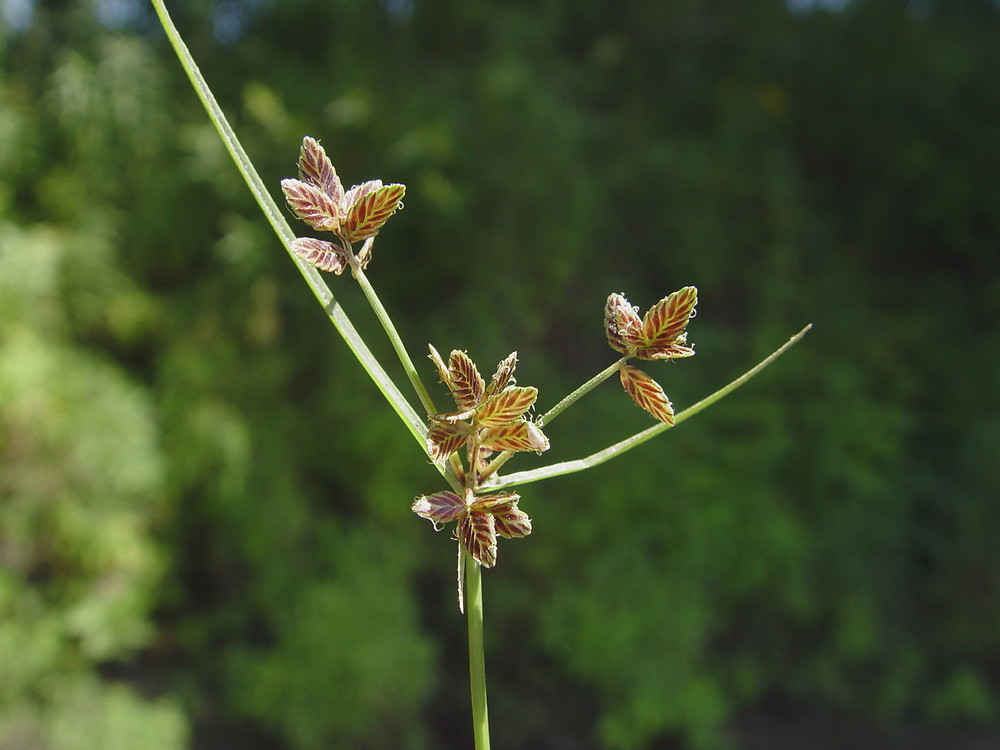 |
| Cyperus bipartitus |
Cyperus bipartitus |
Cladium
Cladium californicum syn. Cladium mariscus var. californicum S. Watson syn. Mariscus californicus (S. Watson) Fernald
 |
 |
 |
| Cladium californicum |
Cladium californicum |
Cladium californicum |